
'80s Roulette: BACK TO SCHOOL
Rodney Dangerfield straightens out his Longfellow in this cheerfully silly star vehicle
I have (almost) every single movie released in theaters in the ‘80s in the United States on a hard drive, and once a week, I’m going to hit shuffle and review whatever film comes up first.
Welcome to ‘80s Roulette!
JUNE 13, 1986
Back to School
Rodney Dangerfield, Sally Kellerman, Burt Young, Keith Gordon, Robert Downey Jr., Paxton Whitehead, Terry Farrell, M. Emmet Walsh, Adrienne Barbeau, William Zabka, Ned Beatty, Severn Darden, Sam Kinison, Robert Picardo, Kurt Vonnegut Jr., Edie McClurg, Sarah Abrell, Dara Allison, Boris Aplon, Nora Boland, Kimberlin Brown, Lisa Denton, Bob Drew, Holly Hayes, Jason Hervey, Leslie Scarborough, James Ingersoll, Michael McGrady, Santos Morales, Beth Peters, Phil Rubenstein, Timothy Stack, Steve Sweeney, Stacey Toten, John William Young, Brad Zutaut, Josh Saylor, William Grauer, Kristen Aldrich, Becky LeBeau, Tricia Hill, Jill D. Merlin, John William James, Eric Alver, Theresa Lyons, Dallas Winkler, Lisa Montgomery, Kimberlee Carlson, Curtis Stone, Michael Reid, Cactus Moser, Brian O’Dougherty, Davey Faragher, Cliffie Stone, Oingo Boingo
cinematography by Thomas E. Ackerman
music by Danny Elfman
screenplay by Steven Kampmann & Will Porter and Peter Torokvei & Harold Ramis
story by Rodney Dangerfield & Greg Fields & Dennis Snee
produced by Chuck Russell
directed by Alan Metter
Rated PG-13
1 hr 36 mins
When a self-made millionaire is worried his son won’t go to college, he also enrolls so he can finally get a degree of his own.
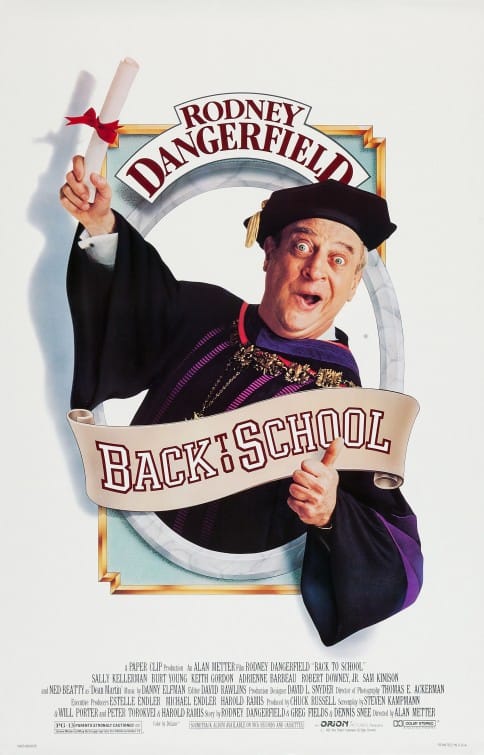
One of the benefits of working at a movie theater in the ‘80s was the ability to watch films over and over with audiences, seeing what played the same every time, learning from them. The summer of 1986 was my first summer as a theater employee, and there were a number of movies that were particularly valuable. James Cameron’s Aliens was a masterclass in suspense and tension, and David Cronenberg’s The Fly showed me how you could play an audience like a musical instrument. If I’m being honest, though, the film that I found most educational during multiple rewatches was Alan Metter’s Back to School, starring Rodney Dangerfield. The film earned just shy of $100 million on a $10 million budget, and it played in our theater from the middle of June until Halloween, earning constantly, and during that time, I saw at least part of the film dozens of times. I would sneak in to watch certain scenes and no matter how long it played, audiences reacted the same way every time. Huge applause. Waves of laughter. And everybody went home happy. That’s not a mistake, either. This is about as finely-tuned a pure comedy vehicle as anyone made in the ‘80s.
To call Rodney Dangerfield an unlikely movie star seems like an understatement. I don’t think I spent enough time praising his contributions in my review of Caddyshack, so let me do so here. In a film full of killer comedians all throwing fastballs, Rodney rolls in and owns the screen every single time he’s on. He doesn’t have an off moment. He is like the Tasmanian Devil, rolling in like a thunderstorm to rain on Ted Knight repeatedly, and I love it. I love the way nothing touches him. From his arrival at Bushwood to that final exuberant “We’re all gonna get laid!”, it’s a perfect performance. Ramis uses him just enough, too. When other people tried building Rodney Dangerfield vehicles post-Caddyshack, the results are decidedly mixed. I’m not a big fan of Easy Money, and ‘90s work like Ladybugs and Rover Dangerfield feels almost embarrassing at this point. But right there in the middle, just one time, someone figured it out and made a Rodney movie where he is the star and pretty much onscreen for the whole film and it is both wall-to-wall funny and genuinely kind of sweet and heartfelt. Considering the broader genre (college comedies) and the decade in which it was made, there are a lot of worst-case-scenario versions of this film that could have been made. Somehow, the version they made makes almost every choice right, and in the process, they made his star shine as brightly as it ever did.
The film opens with Jason (The Wonder Years) Hervey as young Thorton Meloni. He brings home a bad report card and his father chastises him. He tells his son that a man without an education has nothing. The film launches directly into an opening title sequence that shows Thorton’s rise to success as Thornton Melon, the owner of an empire of Fat and Tall menswear stores. Built out of black-and-white photos of New York City street scenes and pastoral shots of suburbia, tracing Thornton’s rise from poverty to wealth. It’s a really well-built sequence with a great Danny Elfman score, and it sets a tone, selling Rodney as sympathetic, no matter how boorish he may be. We see that he’s married to Adrianne Barbeau, who plays his second wife as a perfectly rancid phony, and the party they throw goes delightfully off the rails, leading to Rodney throwing her out. He wants to reconnect with his son Jason (Keith Gordon), whose mother was his first wife. She died about a decade earlier, and while Thornton has thrown a ton of money at the distance between him and his son, it hasn’t really helped. He goes to visit Jason at college, and he learns that his son’s been lying to him about being on the diving team and being in a frat and, well, basically everything. Instead of being angry, Thornton decides to enroll at school with Jason, to support him and also to show his son how important education is. Thornton may have a whole chain of stores and a mountain of money, but he is rough around the edges and self-conscious about his own lack of polish. To grease the wheels, Thornton donates an obscene amount of money to the school, something Dean Martin (Ned Beatty doing genuinely hilarious work) greatly appreciates, and then it’s pretty much one gag after another from that point forward.
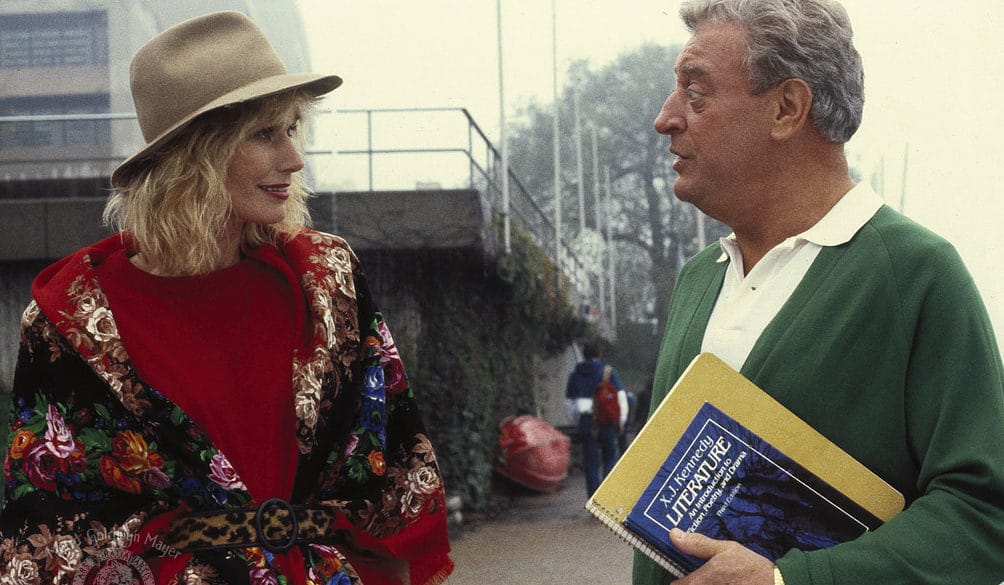
There are some nice surprises in the film. Sally Kellerman plays Diane Turner, Thornton’s English professor who he immediately starts to pursue. This is a world of Three Stooges logic. The film acknowledges that at every turn that this is ridiculous, and again, Elfman’s a big part of that even though he doesn’t contribute a ton of score. There’s maybe 25 minutes of original music in the film, plus a number of pop songs. At one point, Thornton throws a huge party in the dorms, and he apparently builds a customized neon-soaked stage just for Oingo Boingo, who show up playing “Dead Man’s Party.” Kurt Vonnegut appears as himself, young Robert Downey Jr. shows up in gap-toothed motor mouth mode, and William Zabka shows up as a frat boy dickhead who feels like what would have happened if Johnny Lawrence had slightly better grades. Paxton Whitehead is the econ professor who hates Thornton on sight, and every Rodney film needs at least one stuffed shirt he can continuously dunk on every time they cross paths. ’80s All Over favorite Burt Young plays Thornton’s driver/bodyguard Lou, and he is very rumpled and very funny, looking like what would happen if Danny De Vito played Wolverine.
Sam Kinison appears in two scenes as a history professor who is also a Vietnam vet, and his performance was such a crowd-pleasing scene-stealer that Orion immediately signed him to a multi-picture development deal. He set out trying to get a movie made that would reunite him with director Alan Metter, and they quickly settled on Atuk, a long-gestating comedy about an Eskimo who stows away with a documentary crew after they visit Alaska, leading to comic adventures in New York. This almost happened in the early ‘80s with John Belushi starring for Norman Jewison, but Belushi’s death stopped that version cold. This time, it was Kinison and his manager at the time who sabotaged the film roughly two weeks into the shoot, and the plug was pulled. This would have been Metter’s follow-up to Back to School, and when it imploded in a flurry of lawsuits between Kinison, his manager, and the studio, Metter decided to jump into Moving, a Richard Pryor vehicle, and I would argue his career never recovered. It’s a shame, because Metter does such a good job here of making every actor look good. There were a lot of smart collaborators involved on Back to School, including Chuck Russell as a producer and Harold Ramis & Peter Torokvei as screenwriters, and this was a case where throwing a lot of brain power at something resulted in a wholly satisfying confection.
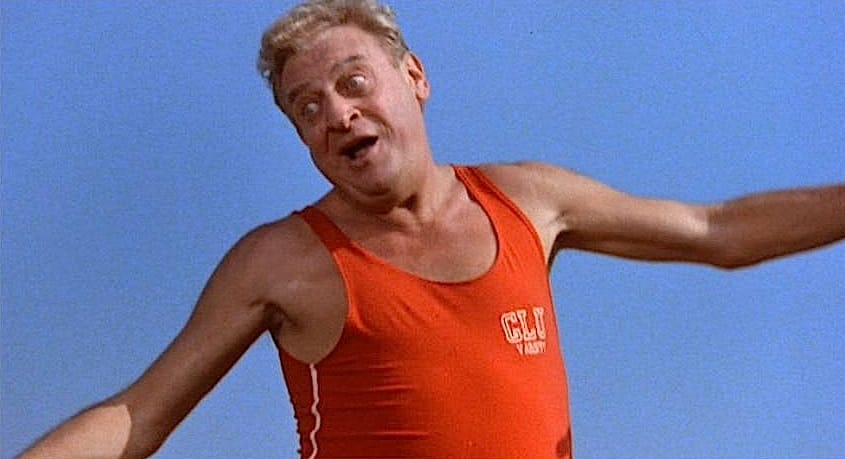
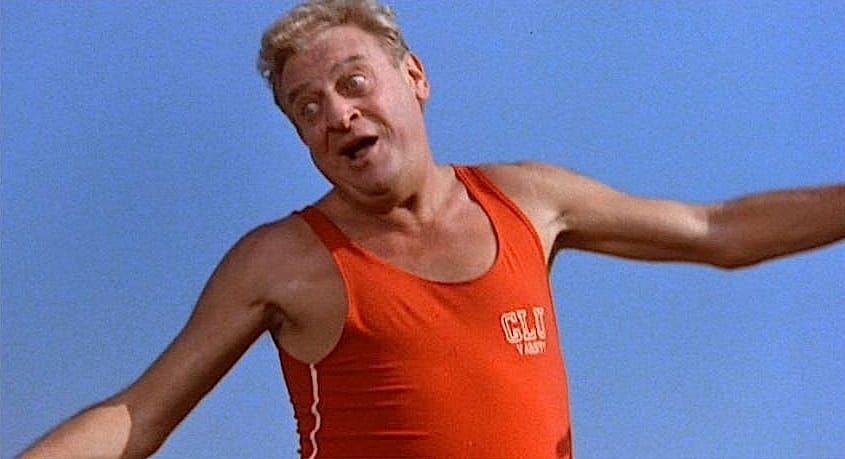
The film ends with two big scenes, one where Thornton has to pass a series of oral exams to prove he hasn’t been cheating all semester long, and one where the school’s diving meet suddenly needs a substitution and Thornton steps in. It made me belly laugh this time because of just how bad the stuntman is for Dangerfield. Guy’s 20 years younger and 50 pounds lighter, and from shot to shot, it is so apparent who’s doing what that it feels like it has to be part of the joke. As I said, this played our theater in Tampa forever, and as a result, there are so many little details that are burned into my head. Every time Rodney uses his eye bulge as a punctuation mark, it makes me cackle. Even 40 years later, I am fascinated by the sandwich Rodney makes at the party at the start of the film, using a whole loaf of bread to house a bunch of different finger foods from the buffet. I think the dorm room that he has built for himself and Jason and Derek (Downey) is incredible. Part of the fun of the film is watching the background actors try not to laugh at Rodney, often failing completely. It is a big rowdy silly film, and it feels even more like a happy accident now looking back than it did that summer.

100% HUMAN-MADE © 2026 by Matt Kindt, LLC is licensed under CC BY-SA 4.0