
FROM THE VAULT: How Rian Johnson rewrote the future of STAR WARS
A special reprint of a PULP & POCORN piece about THE LAST JEDI as a way of celebrating STAR WARS day.
The following piece was originally sold on my Pulp & Popcorn site, and has only ever been available as a standalone purchase.
I decided to republish it today as a snapshot of the moment I was most optimistic about new Star Wars. I understand how things have gone since then, but this piece captures that feeling I had after The Last Jedi, when it truly felt like anything was possible.
I hope you enjoy, and May the Fourth be with you.
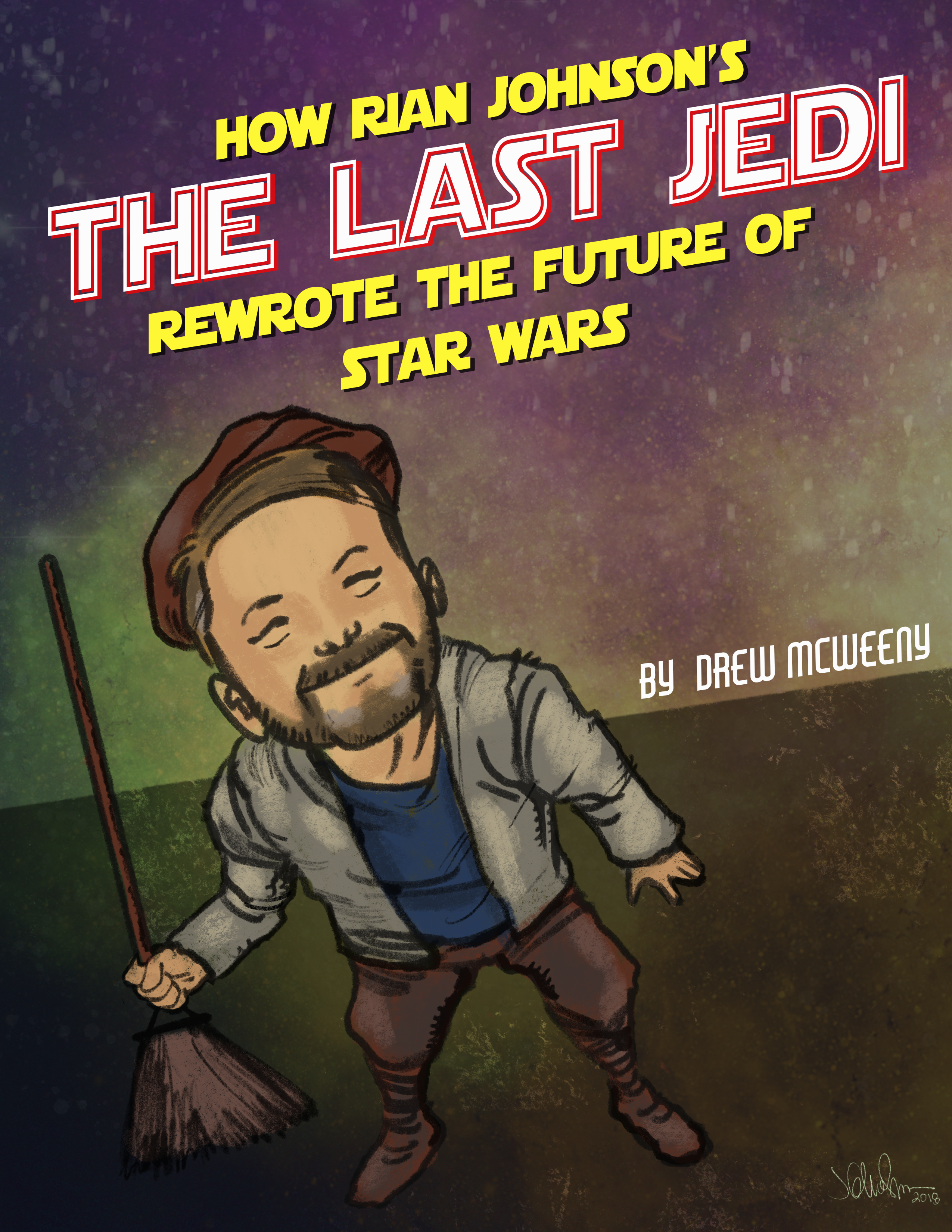
How Rian Johnson’s The Last Jedi Rewrote The Future of Star Wars:
A Deep Dive Critical Analysis
by Drew McWeeny
“Do you want to know the truth about your parents?
Or have you always known?
You know the truth. Say it.
… say it.”
“They were nobody.”
“They were filthy junk traders who sold you off for drinking money.
They’re dead in a pauper’s grave in the Jakku desert.
You have no place in this story.
You come from nothing. You’re nothing.
But not to me. Join me.”
Why do we tell stories at all?
Is it just for entertainment? Are we looking for distraction, or do we want to be enlightened or provoked or in some way inspired? Does the art we consume tell us something about who we are, or who we want to be, or does it simply take our mind off of all the ways in which we are disappointed with the world as it is? If you were to ask that question of George Lucas in the early-to-mid-1970s, he would have told you that art is serious business, and that he was telling stories because they could change the world around him.
Look at the times in which he was telling those stories. “Turbulent” would be a kind way of putting it. When he accidentally created the franchise-driven landscape of modern cinema, he did it in pursuit of something completely different. He was an experimental artist who understood that movies are a popular form, and if he hoped to work in them, he had to find ways to smuggle his intent into something that looked and felt like Hollywood. It’s no accident that Francis Ford Coppola was both mentor and collaborator for Lucas, since Coppola’s biggest creative period is maybe the greatest example of all time of someone making big studio spectacle that was both artistically challenging and commercially satisfying.
When George Lucas made THX-1138 and American Graffiti and started working on the early version of Apocalypse Now, he was working on big themes, and he was working in some very big, varied visual styles. The stark, antiseptic world of THX is very different than the hazy warmth of Graffiti, and when I look at how gorgeous those films are, I mourn the fact that we never got to see his Apocalypse Now. He wanted to shoot in Vietnam using 16mm cameras, shooting in the same style as the news photographers whose work defined that war for Americans. That’s crazy, because he was talking about doing this only a year or two after the end of the war. We’re not talking about shooting Kong Skull Island in Vietnam now, when they’re promoting tourism and the film economy and welcoming you with open arms. We’re talking about taking a film crew into a country we just fought and poking at the still-fresh wound. Say what you will about young George Lucas, but that guy did not lack balls.
When he sold Lucasfilm to Disney, part of me felt like George Lucas was putting a stake in the heart of the Star Wars that I cared about, which was his Star Wars. As a young Star Wars fan, part of what drove that fandom was the stories that fans told about what they’d heard about the future of the series. “There are nine chapters.” “There are twelve chapters.” “We’ll see the past in the next movies.” “They’re going to make one every three years until the year 2001! That’s crazy! We’ll be so old!”