
The Boners: Volume One
A special issue in which we address the problem of mistakes
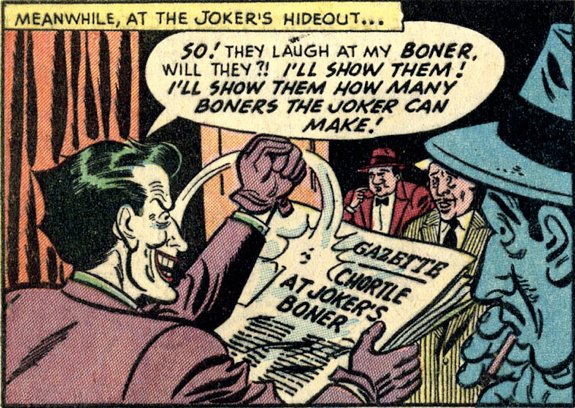
It’s not often that we break format here, but I decided there is a need for a special issue, and if you were a regular listener to ‘80s All Over, you might already have some idea what we’re doing here.
That’s right. Boners have been pulled. Twelve of them, in fact.
I know, I know, I’m 54 years old, but it still makes me snicker that making a mistake used to be called pulling a boner, and I figure if you can’t laugh about your mistakes, that might be a problem. After all, this is a film criticism research project, not open-heart surgery on the President in the middle of a World War. The stakes here are relatively low, and thanks to the magic of editing, I can go back and add things or correct things later if I have to.
I have been working on this project, in one form or another, for at least six years now, and I am still finding clarifications or new information, and as a result, mistakes have been made. So far, those have just been mistakes of omission, and now that I’ve reached ten films that I neglected to include on the dates they were released, I figured I’d back up and send you a special issue with a dozen films that would have been released in 1980 and 1981. If you go back and look at the archives for these issues, you’ll see that these reviews have already been added there. However, if you look at the issues you were sent in your inbox when I first published those months, those reviews are nowhere to be found. Magic!
Even once I make it to December 1989, I will always want to keep this website up and keep it updated with any new information that comes up. I would like to create the best one-stop research tool for every single film released in the ‘80s, and I don’t look at this kind of correction as a pain or a burden. I love it when I learn something new or pin down some release I’d never heard of because I know I’m one step closer to doing this job right and getting the project finished.
In fact, I’d like to talk about methodology, because that’s one of the reasons you’re reading these twelve reviews. When I started working on this project in its initial incarnation as ‘80s All Over, one of the reasons it felt like such a good idea is precisely because there was no single resource we could turn to as research. There is no good comprehensive list of all of the theatrical releases of the decade, in order, with all of the dates correct. And even if there were, there is no place to watch a surprising number of these films anymore. It’s not a question of whether you do or don’t want to pay for them. They are simply not in circulation and they haven’t been for years in many cases. There are so many different reasons, and so many different companies that don’t exist anymore, and ownership issues on some of these films have become entangled. Music rights can make things complicated even for films that studios would like to release. As we prepared to put our first few episodes together, I was immediately amazed by how hard it was to find some of the films.
In mid-November of this year, I finally added the last handful of titles I’d been searching for to the Plex server that I started specifically to create a digital reference library I could refer to for the podcast. Even after the podcast ended, though, I kept refining the list that I built, adding new titles, correcting information that the show got wrong. By the time I started this newsletter, I felt like I had enough of the films here that I’d be able to fill in the gaps by the time I would need things. I had made connections with collectors and archivists who all had specific interests and knowledge that helped me track titles down. All told, I’d say it was almost six years of effort to find the 2800 or so titles that I’ll be reviewing before this newsletter is finished. Hell, when I started, I didn’t even know what a Plex server was. All I knew was there were too many films that were not available either online or physically, and there’s no way to do this newsletter properly if you can’t actually see the films.
A lot of what I have is in dubious quality. Some of these titles were never issued in any format after VHS. Some of them have only ever aired on cable. I would argue that there are very few other places aside from my server and a few other private servers where every single one of these films have been collected together. At this point, this is a piece of cultural history that feels like it has a value larger than something monetary. When you look at these films in order, you can see the evolution of the entire industry, both here and abroad. The 1980s were a pivotal decade for studio films and for independent cinema as well. If you love the ‘70s, it is fascinating to watch the way that decade’s adventurous spirit continues to resonate through the ten years that came right after, and if you’re a fan of the ‘90s, it’s amazing to watch all of the seeds get planted that eventually bloom into one of the richest independent explosions the industry has ever seen.
The reason I remain dedicated to finishing this project is because of just how passionate the responses have been from people who discover the podcast or the newsletter, and they read a review for something they had forgotten completely and they are immediately transported back time to some video store where they saw the box on a shelf or some lazy afternoon when they stumbled across it on HBO or the SuperStation. I am an archivist. I am an archaeologist. I feel like this is so much more rewarding to write than reactions to brand-new films, and I appreciate all of you who continue to support this project.
With that said, my first mistake was in the first issue, and ten of my mistakes took place in the first year of the project. Let’s hope I can keep that number much lower as we move forward, and let’s grab that first boner and get this going!
1980
JANUARY 11
The Godsend
Malcolm Stoddard, Cyd Hayman, Angela Pleasance, Patrick Barr, Wilhelmina Green, Joanne Boorman, Angela Deamer, Clarissa Young, Lee Gregory, Piers Eady, Anna Wing, Artro Morris, Hilary Minster, James Snell, Corinne Skinner-Carter, Jonathan Elsom, Bernard Taylor
cinematography by Norman Warwick
music by Roger Webb
screenplay by Olaf Pooley
based on the novel by Bernard Taylor
produced by Gabrielle Beaumont
directed by Gabrielle Beaumont
Rated R
1 hr 33 mins
An abandoned newborn is taken in by the Marlowe family, but tragedy plagues them from the moment they bring her home.
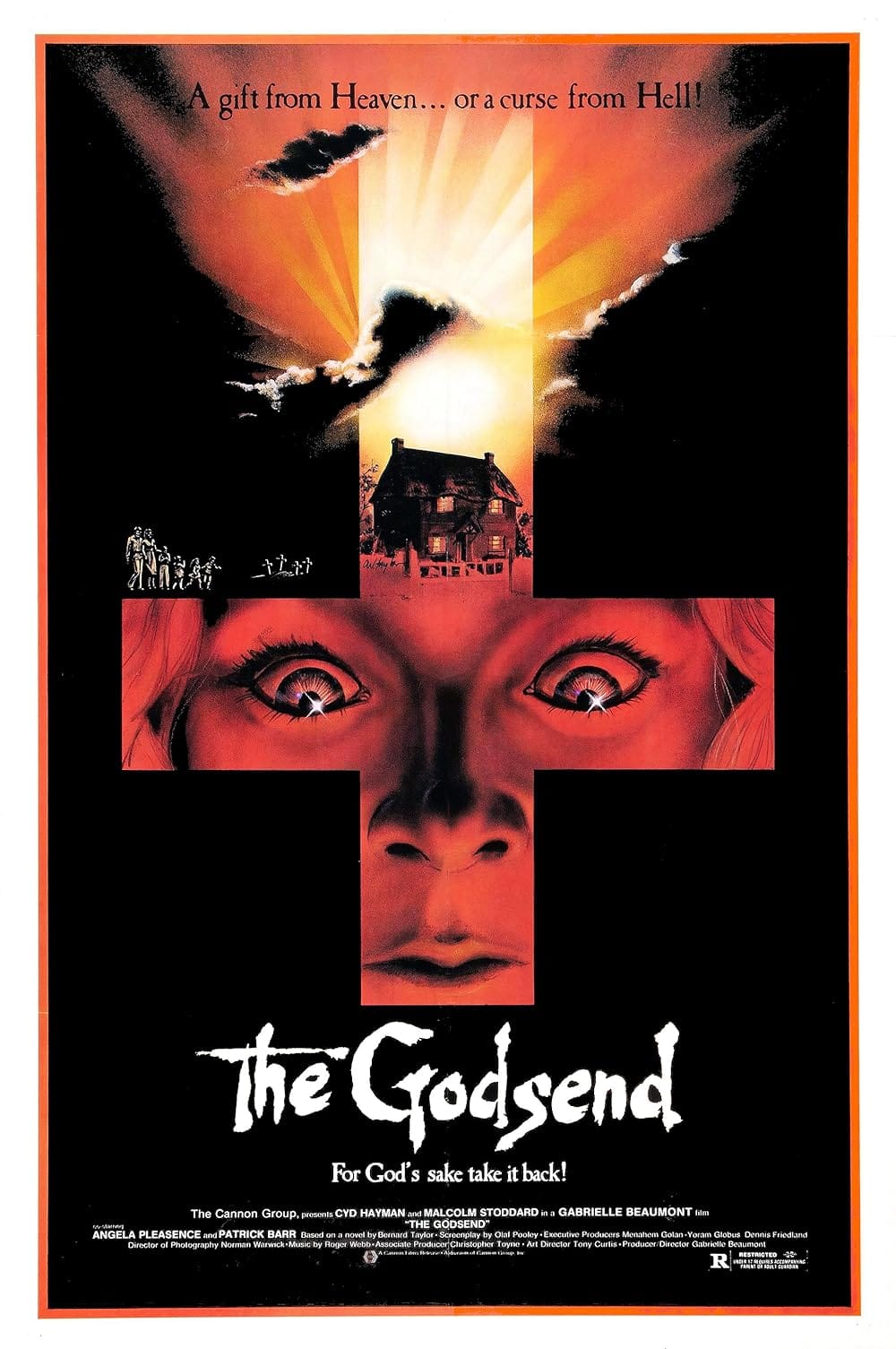
Gabrielle Beaumont is famous for many things, and justifiably so. She was the first woman to direct a Star Trek episode. She was Emmy-nominated for her work as a director on Hill Street Blues. She was the person who pushed to cast Joan Collins in Dynasty. She made the other Dorothy Stratten film in the ‘80s, the one with Jamie Lee Curtis. But in 1980, she made her feature debut with a film adapted by her screenwriter husband Olaf Pooley from a Bernard Taylor novel, and the result was a startlingly mean-spirited killer kid movie that is largely forgotten today.
This is one of those sub-genres that never really breaks out, but every now and then, one of these movies makes just enough noise to inspire a few imitators. The Godsend feels like it was made because of the success of the Omen films. Produced independently in the UK, the film was released in the US by Cannon, and they sold it fairly accurately. My guess is that the reason you don’t know this film immediately is because it’s a genuinely nasty bit of business, a story about a supernatural cuckoo who drops a chaos agent into the lives of the the Marlowe family to deadly effect. The movie is pretty much a blunt object. There is nothing subtle about it. When we meet the Marlowes, they’re all out as a family. There’s Alan (Malcolm Stoddard) and Kate (Cyd Hayman) and their four children, but not for long. After an encounter with a strange pregnant lady (Angela Pleasance, daughter of legendary character actor Donald Pleasance), they bring her back to their home. She ends up giving birth and then taking off. For some insane reason, Kate wants to keep the baby, and almost as soon as baby Bonnie becomes part of their family, their own baby ends up dead in his playpen.
As Bonnie gets older, mysterious accidents continue to plague the other Marlowe children, killing them off one by one, and Bonnie is always right there in the midst of things. For some reason, Alan and Kate are too stupid to do the math. It is a shockingly linear story, and it does feel like a singular riff on the entire idea of the “killer kid” movie. For the most part, the kids in these films kill off adults for one reason or another. Not Bonnie. Her sole purpose seems to be the destruction of every actual Marlowe child and then, eventually, the destruction of the family itself. The film ends on an ugly bleak note, which makes it feel more like a hangover from the ‘70s than any kind of ‘80s movie. On a technical level, this feels like a television film, and that probably shouldn’t be a surprise. As I said, Beaumont is a legendary TV director. This is not a bad film or an incompetent one, but it is cheap and it does feel like something that was shot fast. If you like your horror bleak and nasty, you might like this slow-burn slice of mean, but it’s largely forgettable fare overall.
Our Hitler: A Film From Germany
Heinz Schubert, Peter Kern, Hellmut Lange, Rainer von Artenfels, Martin Sperr, Peter Moland, Johannes Buzalski, Alfred Edel, Amelie Syberberg, Harry Baer, Peter Lühr, André Heller
cinematography by Dietrich Lohmann
screenplay by Hans-Jürgen Syberberg
produced by Bernd Eichinger
directed by Hans-Jürgen Syberberg
Not Rated
7 hrs 22 mins
Four individual segments explore various facets of Hitler, his relationship with Germany, and his impact on the country’s character in a dazzling mixed-media presentation.

It is hard to do justice to the overwhelming weight of Hans-Jürgen Syberberg’s epic post-mortem of the life and influence of Adolf Hitler. I cannot imagine seeing this theatrically, although New Yorkers had the opportunity to see it screened that way last January thanks to Film at Lincoln Center. Presented in its original American bookings by Francis Ford Coppola, it is a difficult movie by design, punishingly long, and it is the length of the film as much as the subject matter, that makes it such a rarely-programmed event.
While the film focuses on the people around Hitler, like Himmler or Heinz Linge or Otto Günsche, it is ultimately a kaleidoscopic attempt at examining the way Hitler rose to power, the way discussions of Nazi Germany inevitably simplify an almost unimaginable human evil into something we can digest, and the notion that Hitler was more than a person, but more of an inevitable expression of an entire nation’s worst impulses and ideas. It is completely unrealistic, even though it often uses documentary footage, historical archives, and actual propaganda from the time, and that seems to be the point. It is as much about the way we digest Hitler as it is about Hitler himself, and when it was originally released in America in 1980, there were breathless pieces written about it. It is the kind of experience that feels like Art-with-a-capital-A, often oblique but always intentional, and it is largely impossible for people to see easily at this point, although the Internet Archive has a slightly truncated version available for the curious.
I do not consider myself any kind of expert on WWII, and one of the things this film explores is the way people continually poke at the collective memory of Hitler for a variety of purposes. Yes, it is important to understand history and what led to certain events or ideologies, but there is an entire industry that exists to constantly slow drip this stuff as entertainment, and much of the approach to the way Syberberg presents information here feels like a reaction to that and an attempt to counteract it. He has no interest in glorifying Hitler in any way or even of presenting him as magnetic. He is working against the entire idea of breaking history down into “heroes” and “villains,” and not because he’s worried he might romanticize Hitler. I think he feels more worried that reducing someone to a bad guy means never having to look into the mirror that these people provide. More than that, he feels that people will spend so much time studying Nazism that they will start to admire it inevitably, and I know I personally get creeped out by people who collect Nazi artifacts or who spend the majority of their time soaking up Nazi ideology, even under the guise of academia. He argues that “never again” is essential, but how do you keep the memory of horror actively alive without potentially pave the way for people to repeat the same mistakes again?
The first of the film’s four segments is largely focused on the way Hitler expertly exploited the idea of “cult of personality” and the role propaganda played in getting his message across to the German public, while the second part explores the ways that propaganda used nationalism and religion to create and inspire the Nazi culture. This is heady, difficult stuff, and I found myself horrified by the thoughts all of this inspired in me about the moment we are currently in. This is a brash, confrontational, harrowing film, and that seven-hour-plus runtime is part of the experience. It assaults you. Spending seven hours with this material starts to make you feel physically and mentally unclean, and by the time you get to the prolonged sequence with the Hitler puppet, you will feel like reality has shredded completely around you. One of the accidental statements that the film makes is that even at this length, even with this assault of information and ideas, it is clear that Syberberg still had to get reductive in some of his points, and that he has done exactly what he is criticizing. It is fingerpainting by sledgehammer, self-serious and overstuffed, and I was disturbed by it just as much as I was frustrated by it. It is singular and feels like it exists beyond conventional criticism. In some ways, I felt more pulverized by the size of the film than by what it was saying, and I’m not even sure I’d call Syberberg a filmmaker in any conventional sense. He is interested in creating gesamtkunstwerk, art that attempts to use various different kinds of art at the same time. Opera and live theater and documentary and still photography and puppeteering and everything else he can use are all part of this presentation. Later in life, Syberberg was often controversial, and his personal politics were hard to parse. There is no denying that this one project of his feels like an important, if specific, contemplation of one of the defining moments of modern history, no matter what message you take from the overall experience.
FEBRUARY 1
Survival Run
Peter Graves, Ray Milland, Vincent Van Patten, Cosie Costa, Robert Weaver, Susan Pratt, Marianne Sauvage, Randi Meryl, Daniel Ades, Pedro Armendáriz Jr., Gonzalo Vega, Anthony Charnota, Conrad Hool, Elizabeth Kerr, Hymie Habif, Lance Hool, Michael J. London, Deanna Dae Coleman, Mischa Hausserman
cinematography by Álex Phillips Jr.
music by Gary William Friedman
screenplay by Larry Spiegel & G.M. Cahill & Fredric Shore
story by G.M. Cahill & Fredric Shore
produced by Lance Hool
directed by Larry Spiegel
Rated R
1 hr 29 mins
Six horny teenagers run into drug traffickers in the desert and are forced to fight for their lives.

I try to approach every review in this project equally, giving every film my full attention. I try to be open to the possibility that every film could be a gem that has been forgotten, no matter how obscure. I try to be generous to small films, conscious of the resources available to them. I want to be more descriptive than critical in these pieces. I feel like there’s a chance every movie here is someone’s favorite.
Not this one. This is a piece of shit, start to finish.
Fans of bottom-of-the-barrel crapsloitation are familiar with the efforts of FVI, or Film Ventures International. Kicking things off with a nudie flick in the late ‘60s, the company made a ton of money by importing Italian films and tinkering with them for the American market. They also produced their own films, though, and one of their biggest hits was Grizzly, a shameless Jaws ripoff. Fans of Mystery Science Theater 3000 know some of their films, like Pod People and Cave Dwellers, some of the most beloved episodes. We’ve covered a number of their films already, including The Visitor, Kill or Be Killed and its sequel, Kill and Kill Again, and there will be plenty more before we’re done with this project, god help us all.
Survival Run is one of their worst films, full stop. It is barely coherent, and every single technical aspect of it is sub-standard. Larry Spiegel only directed a few times, and it is safe to say he had zero aptitude for the job. There’s not a single “scene” in the film that feels like it was shot with intent or purpose. Things happen in front of a camera, and some of those things involve professional actors, but there’s not even a hint of a pulse to any of it. The basic plot synopsis sounds like a hundred other low-budget action films, but describing this film that way would imply there is actual action in it. There. Is. Not. The film opens like someone pressed play in the middle of a shitty teen comedy, and when the film does finally take a left turn by introducing the drug traffickers, there is zero tension to any of it.
The film was made in 1978, and even after they eventually took it off the shelf, they couldn’t decide on a title or how to release it. The one thing they did get right is the poster for the film. Look at that thing. That makes promises this movie has zero interest in fulfilling, and the film ends with a very cynical set-up for a sequel, which feels doubly contemptuous after sitting through a movie this indifferently made. When you see people like Peter Graves and Ray Milland in something this bad, you can only assume they were in dire need of money. Whatever they were paid, it was not worth it.
FEBRUARY 29
Terror On Tour
Rick Styles, Chip Greenman, Rich Pemberton, Dave Galluzzo, Larry Thomas, Jeff Morgan, David Thompson, John Wintergate, Kalassu, Camelia Lynne, Sylvia Wright, Ann Davis, Verkina Flower, Rhonda Cacioppo, Franklyn B. James, John Green, Lindy Leah, Lisa Antille, Serlet Lamay, Mikey O’Roark, Penny Shelton, Liz Debean, Gale Carol, Roger Fouts, James W. Roberson, Sheila Davis, Dora Rodriguez, Pamela Johnson, Kimberley Bennett, Suzan Fellman, Sandy Cobe
cinematography by James W. Roberson
music by The Names
screenplay by Alex Rebar
produced by Sandy Cobe
directed by Don Edmonds
Not Rated
1 hr 27 mins
Someone is killing the fans of the Clowns. Is it one of them, or just someone wearing their signature style?
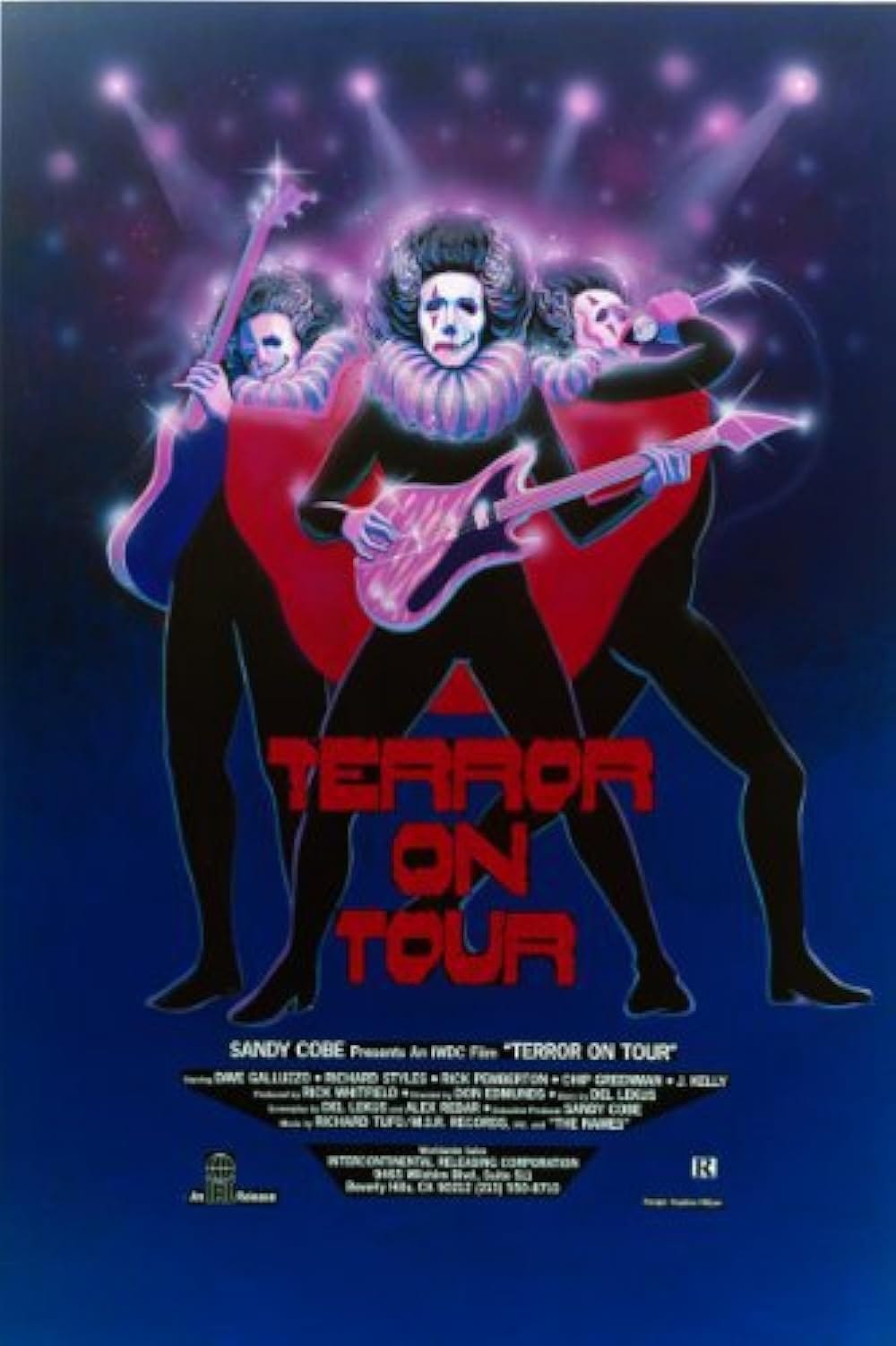
Truly inept on every level, this mix of rock music, softcore porn, and terrible slasher tropes is one of the ugliest barnacles on ‘80s horror that I’ve had to review here. Real-life band The Names plays a band called The Clowns here, and they look like a gang that Walter Hill rejected from The Warriors for looking too silly. They are not actually on tour in the film, but are instead playing a residence in an anonymous shithole where things play out in a Groundhog Day-like cycle of cocaine, groupies, and badly-mixed sonic sludge.
When someone start killing groupies after every show, the cops start to investigate. Meanwhile, someone else might be dressing up as one of the Clowns in order to have sex with groupies. Is that the same person who is also killing them while dressed that way? Honestly, who cares? Not the movie, that’s for sure. Don Edmonds, one of the masterminds of the Ilsa: She-Wolf of the SS series, is still working sleazy here, but it’s half-hearted compared to some of his earlier, sleazier work. The film’s big finish is a complete shrug, and even if you’re looking for cheap exploitation thrills, the film feels like it can barely be bothered to go through the motions.
MARCH 14
Last Rites aka Dracula’s Last Rites
Patricia Lee Hammond, Gerald Fielding, Mimi Weddell, Victor Jorge, Michael David Lally, Alfred Steinel, Eric Trules, Gordito, John Juback, Joe Perce, Rain Worthington, Dan Freedman, Suzy Brabeau, Michael Valentine, Mark Bennett, Leah Vitale, Steven Vitale, Brian Nonnenmacher
cinematography by Domonic Paris
music by Paul Jost and George Small
screenplay by Ben Donnelly and Domonic Paris
produced by Kelly Van Horn
directed by Domonic Paris
Rated R
1 hr 26 mins
A group of vampires use a funeral home as a cover and have to destroy a newly-created vampire before she exposes their whole operation.

Calling this film “no-budget” would be a compliment. The entire thing looks and feels like it was lit by overhead projectors and shot on thinly sliced ham. It is genuinely amazing this ever played in an actual theater.
The film opens with a couple of white trash couples drag racing on a remote stretch of road. One of the cars flips. The other couple takes off before help can arrive. When it does, it’s in the form of an ambulance, and the “dead” couple is loaded into the back and taken to a funeral home that is owned and operated by an A. Lucard. If you’re not already ten steps ahead, it turns out the girl isn’t dead, but as soon as the vampires who run the funeral home finish feeding on her, they stake her since as soon as these vampires bite you, you turn. It’s a perfect scheme, right? Well, no, and things go wrong very quickly.
The next time A. Lucard (the shortest, goofiest, baldest Dracula in movie history) pulls this trick, it’s an old lady who is next to death. The family wants to hold the funeral at their home, which poses a problem for Lucard because she’s been bitten, but not staked yet, and it’s up to Lucard to retrieve the body before she can rise and start attacking people on her own. If that happens, the whole operation is exposed and they’ll have to leave town. He’s not alone, either. The Sheriff and the Doctor (this is a really small town) are also both vampires and part of the conspiracy. The “hero” of the film is a dude named Ted. The old lady is his mother-in-law, and he starts to figure out something is up based on the way everyone acts once they bring Mrs Bradley’s body home. The attempts they make to get the body back are so silly they should be scored to “Yakety Sax.” Absolutely nothing interesting happens, and then it’s mercifully over. Domonic Paris has spent the 2000s writing and producing straight-to-video CGI children’s fare and based on how many of them he’s made, he has to be better at that than he is at horror, because this thing is a grade-A sleeping pill.
OCTOBER 10
The Attic
Carrie Snodgress, Ray Milland, Ruth Cox, Angel, Rosemary Murphy, Frances Bay, Fern Barry, Marjorie Eaton, Dick Weisbacher, Joyce Cavarozzi, Michael LeRoy Rhodes, Ron Luce, Phil Speary, Patrick Brennan, Mark Andrews, Terry Troutt, Zale Kessler, Mason Armin James
cinematography by Gary Graver
music by Hod David Schudson
screenplay by Tony Crechales and George Edwards
produced by Raymond M. Dryden and Phillip Randall
directed by George Edwards
Rated PG
1 hr 41 mins
A woman, trapped in a miserable life taking care of her immobilized father, fantasizes about a life without him.
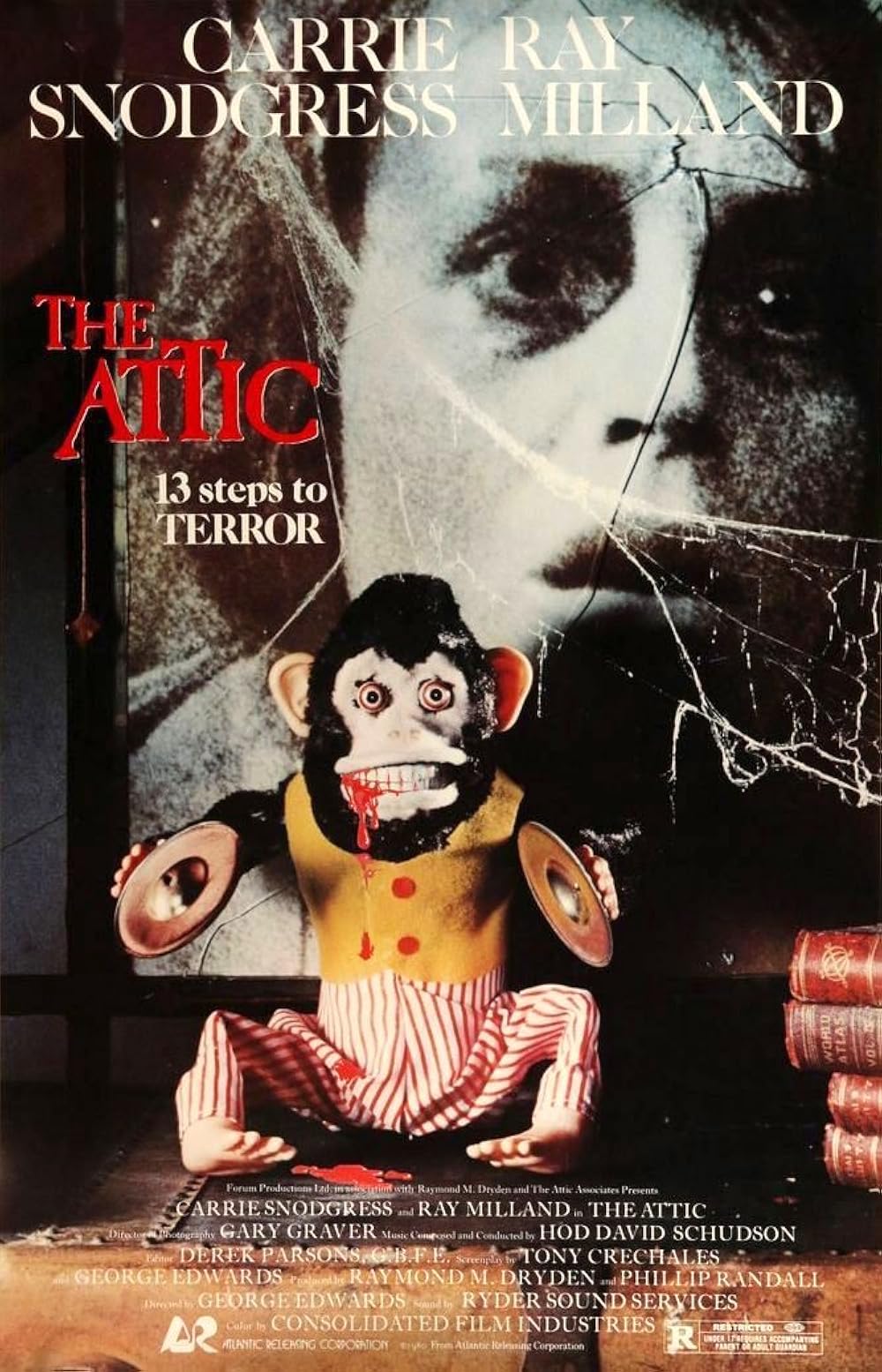
This is an odd film, start to finish, and I’m not sure it’s fair to describe it as a horror movie. That poster certainly sells it as horror, and there are a few beats that are horrific, but for the most part, this is a long, strange movie about a woman trapped in a psychologically abusive relationship with her wheelchair-bound father. Carrie Snodgress and Ray Milland are pretty much the whole show here, and they’re both playing it for all the Baby Jane they’re worth. But is it horror? Really?
As the film opens, Louise (Snodgress) lays in a bed, her wrists bleeding from deep, fresh cuts. The next time we see her, she’s at work at the small-town library where she’s worked for years. That’s ending, though, and from her conversations, her behavior, and some conversations the locals have with Emily (Ruth Cox), the new librarian who’s been hired to replace Louise, it’s clear that Louise is going through some kind of breakdown. She drinks constantly and she evidently started a fire in the library. Small wonder. When we see her home life, it’s awful. She and her father Wendell (Milland) put on these little one-act plays of horrible dysfunction for themselves every night. Louise almost got away once, but her fiancé disappeared just before their wedding, shattering her and pretty much dooming her to a life spent caring for her father.
She and Emily strike up an unlikely friendship, and we see how lonely Louise is, allowing herself to be picked up at a movie theater by a sailor for an empty late-night encounter. Emily is a good fifteen years younger than Louise, and she hates seeing the older woman’s depression. I’m not sure how their local pet store has chimpanzees in stock, but when Emily sees Louise’s reaction to a chimp in a window display, she buys her one. That is maybe the most insane gift I’ve ever seen anyone give someone else in a movie, and there’s a good chunk of the film that deals with Louise’s deep affection for Dickie, her new chimp, and the way Wendell hates the chimp right away. Hilariously, the feeling seems to be mutual, and there’s a real battle of the wills between them that Louise doesn’t notice at first. Milland starts pressing her to get rid of the chimp, leading to a fantasy in which she murders Wendell with the help of a man in a gorilla costume.
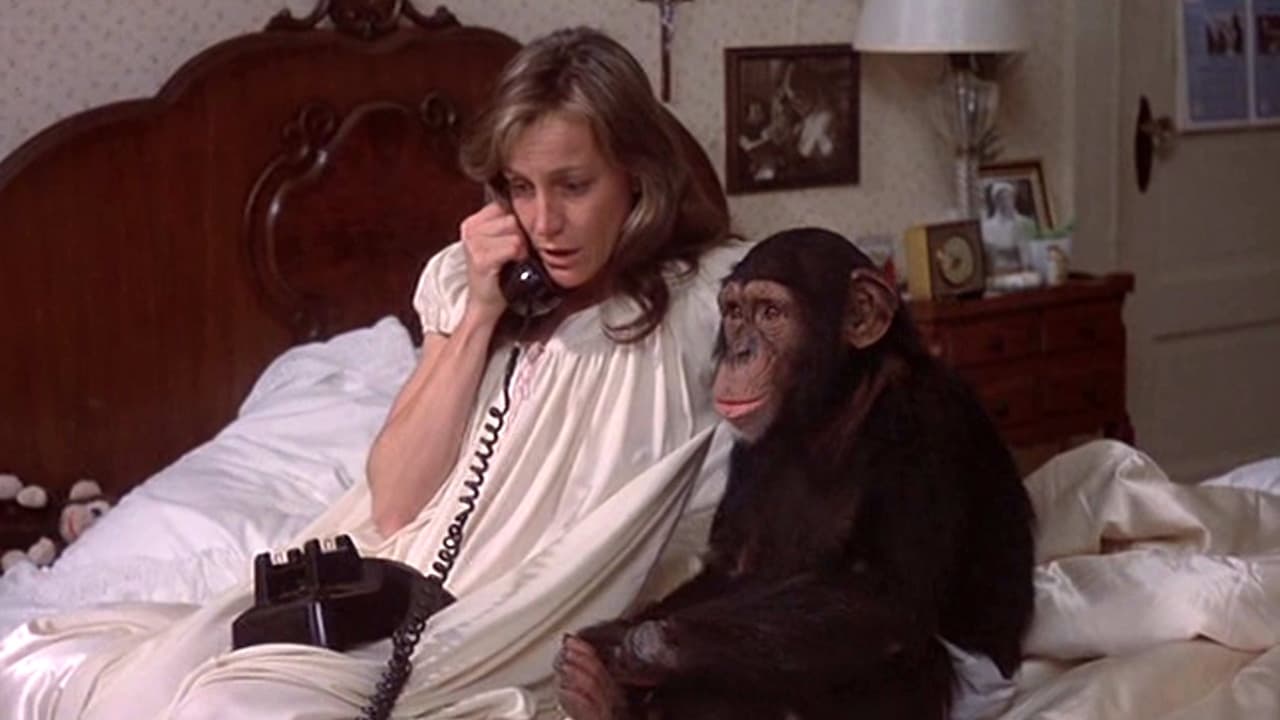
Oh, did I mention the fantasies? They’re part of a lot of the conversations between Louise and Wendell. She imagines smashing him in the face with a cake or poisoning him or, yes, killing him with a guy in a gorilla costume, and then reality snaps back. It’s a pretty significant part of the film’s language, but they’re so broadly played and so silly at times that I don’t think you can can call any of this “horror” in any way. The film’s saddest scene plays out when Louise mistakes a young man mowing her yard for Robert, her long-lost boyfriend. She’s spent the whole movie waiting for him to show up and take her away and for this one uncomfortable moment, she can’t tell what’s real and what’s not.
Louise gives Emily advice that all basically boils down to “For god’s sake, don’t be me.” After a dinner at Emily’s house and a good long look at her mother, Louise urges the girl to go to Los Angeles to try to make things work with her boyfriend. She knows she’s never getting away from her father, and she can recognize Emily’s mom as the exact same kind of emotional vampire, bullying her children into never leaving her. Snodgress makes some strong choices as Louise, and whatever you think of the film will depend largely on what you think of her work. Ruth Cox, who plays Emily, didn’t last long in the film industry, and it’s a shame. She’s appealing, and she does nice work with Snodgress. Milland is a real toad in the movie, which is exactly what he was hired to be, and by the time the film reaches its final stretch, you’re ready for Louise to stand up to him, one way or another.
Snodgress is a terrific character actor whose career might have gone differently if she’d accepted the role of Adrian in Rocky. It was hers to refuse, and she already had an Oscar nomination to her name for Diary of a Mad Housewife. She asked for more money than MGM was willing to pay her and that was that. If you’re a Neil Young fan, you probably already know Snodgress was the muse behind some of his most affecting work, like “Heart of Gold,” “A Man Needs A Maid,” and “Harvest.” When Louise comes home and finds Dickie missing, Wendell says he has no idea where the chimp might be, and Louise is heartbroken. From there, things spiral quickly, leading to a series of reveals that almost tip the film into horror territory. Again, though, the story being told here is sad, more than anything. Milland’s a monster, but that’s not what the film is doing. It’s Louise’s story, and everything is so stacked against her that we want her to stand up to Wendell. I’m confused about what’s supposed to be “scary” in the film. It’s more a psycho-drama than anything, and pays off in a fairly brutal final scene that plays like Edgar Allen Poe via Tennessee Williams.
The score by Hod David Schudson is effective, and it’s a real shame his life and career were cut short just a year or so later. Tech credits are strong in general, and Gary Graver’s photography is noteworthy. I’ve seen Graver listed as an unofficial co-director on the film, and considering this is the only credit George Edwards, a profoundly schlocky writer-producer, has as a director, I’m inclined to believe Graver might have been largely calling the shots. Graver, who we’ve talked about repeatedly in this newsletter, worked closely with Orson Welles for a chunk of his life, and he worked with Corman and Cassavetes before directing his own occasional films. He was also a guy who worked in the adult industry under a different name, shooting and directing hundreds of films. He was technically adept and obviously collaborated with film artists with strong, distinct voices sometimes. This is not a bad movie or an inept movie. It is, as I said at the start, odd, though, and even as the closing credits role, I find myself unsure what it is the filmmakers are trying to leave me with. It is sad and kind of ugly, but well-told and well-acted, and if you make the mistake of throwing it on looking to be scared, you will be frustrated by it. But The Attic is one of those little films I won’t forget, even if I’m not sure exactly what it’s saying.
NEXT TIME
Can you believe there are still six more boners?!
It’s just as weird and random a line-up next time. You want a Lee Majors movie? Well, you’re getting one anyway. How about a Tommy Smothers comedy? Just what everyone has been demanding. There’s a very strange movie that’s kind of about Elvis and a charming Belgian import.
And then we’re heading into June 1985, which is a month many of you have been itching for since the start of ‘80s All Over. You’re going to want to be here for that, and maybe you know someone else who’s going to want to read about Pale Rider (oh, look, it’s Carrie Snodgress again), Cocoon, Return to Oz, St. Elmo’s Fire, Lifeforce, or a little ditty called The Goonies. Consider the joy you’d generate with a gift subscription for your friends with exceptional taste.
I’ll have the final boner bouquet for you soon, and then there’s so much more to get to in 2025. See you back here in just a few!