
The Boners: Volume Two
Tommy Smothers, Lee Majors and... Elvis Presley?!

You guys seemed to respond well to volume one of this grab-bag of titles that were left out of the initial emails sent to you when covering 1980 and 1981. There are six more films that I missed, and again, it’s a very strange assortment of things.
As a critic, I am most interested in context, setting a film into the proper framework so that you can judge it not in a vacuum but as part of a larger living, breathing ongoing conversation that is cinema. And, yeah, that’s a big word to use for some of these movies, but part of doing this project the right way is approaching all of these films equally. In rewatching everything in order, grouped the way they were grouped on release, you do see a larger story emerge. You watch the way success ripples through the years around it, and the same is true of failure. You watch careers rise and fall or sputter out before they really take off. I’ll always happily go back to correct a mistake in this newsletter because it means that the final version, the one that exists at the end of all of this, will be the best-researched and most comprehensive online resource about the film of the 1980s.
After all, if there’s something you wish you could read and it doesn’t exist, it’s up to you to make it happen.
Your ongoing support of this newsletter is an important part of the process, too, and if you aren’t already subscribed, it really does make a difference. Help me make it to the end of the decade this time.
That said, let’s jump right in with a movie that posed a difficult marketing problem for a distributor that believed wholeheartedly that they had a hit on their hands…
1980
OCTOBER 31
Touched By Love
Deborah Raffin, Diane Lane, Michael Learned, John Amos, Cristina Raines, Mary Wickes, Clu Gulager, Twyla-Dawn Vokins, Clive Shalom, Jason Bates, Joseph John Bondok, Beverly Chapman, Jennifer Collins, Cathy Corns, Rhonda De John Hanif Mawji, Robbie Olisoff, Melissa Quigg, Darren Taylor, Sharlene Taylor, Darren Wall, Carla Wildeman, Gordon Bullivant, Darrel Beingessner, May Brackenbury, Lluella Dickson, Patti Gunther, Ruth Harwig, Margaret Kuyt, Juane Priest, Dorothy Shalom
cinematography by Richard H. Kline
music by John Barry
screenplay by Hesper Anderson
based on the book To Elvis With Love by Lena Canada
produced by Michael Viner
directed by Gus Trikonis
Rated PG
1 hr 35 mins
A new therapist starts working with a troubled girl and makes important breakthroughs, eventually helping the girl become pen-pals with Elvis Presley.

Deborah Raffin’s relatively thin theatrical filmography seemed to consist primarily of films that distributors weren’t sure what to do with.
We’ll get to the very strange Dance of the Dwarfs later, but as the decade began, she was on the cusp of actual movie stardom, and this movie was supposed to be the vehicle that took her there. Based on a memoir by Lena Canada, Touched by Love tells the true story of a therapist working at a school for disabled children who helps a girl with severe cerebral palsy connect to the outside world, in part through a pen-pal relationship with Elvis Presley. Raffin stars as Lena, and Diane Lane plays Karen, the teenage girl who Lena helps. It is a treacly movie, but it’s impossible to be upset by it. The film means well, and Raffin gives it everything she’s got. Raffin was a model first, but when her TV movie Nightmare in Badham County became an overseas theatrical hit, she had a moment of almost stardom. Touched by Love was her biggest shot at movie stardom, and it pretty much bounced right off the box office, even after she was sent to do one of the first major press tours for a movie by a Western star in China, where Badham County was a phenomenon.
The first forty-five minutes of the film are focused on the initially difficult relationship between Lena and Karen, who is almost completely non-verbal when they meet. Lena’s hired to work at a school for “special children,” a broad umbrella term that covers a number of different developmental or congenital disabilities. Most of the kids in the school are played by children who are genuinely disabled, and almost none of them are given any lines of dialogue. In the closing credits, there’s a special thanks to The Dr. Gordon Townsend School of Calgary, Canada. The top-billed kid from the school is Clive Shalom as Topper, but everyone else is just listed under their own names, including the teachers. The only kid besides Karen who gets a credit is Twyla Volkins, who plays her best friend, Monica. As with the kids, there are a few actors playing the nurses and teachers, including Clu Gulager, John Amos, and Cristina Raines, and they do most of the heavy lifting, treating all the real teachers and students like extras that lay down a base level of reality against which the melodrama can play out. For a while, Raffin plays her scenes to a silent Lane. Gradually, she starts to win Karen over, and eventually, Karen opens up, talking to Lena about everything. Lane plays Karen with a fair amount of restraint, even when the script really pours the syrup on, and the script is shameless, to be clear.
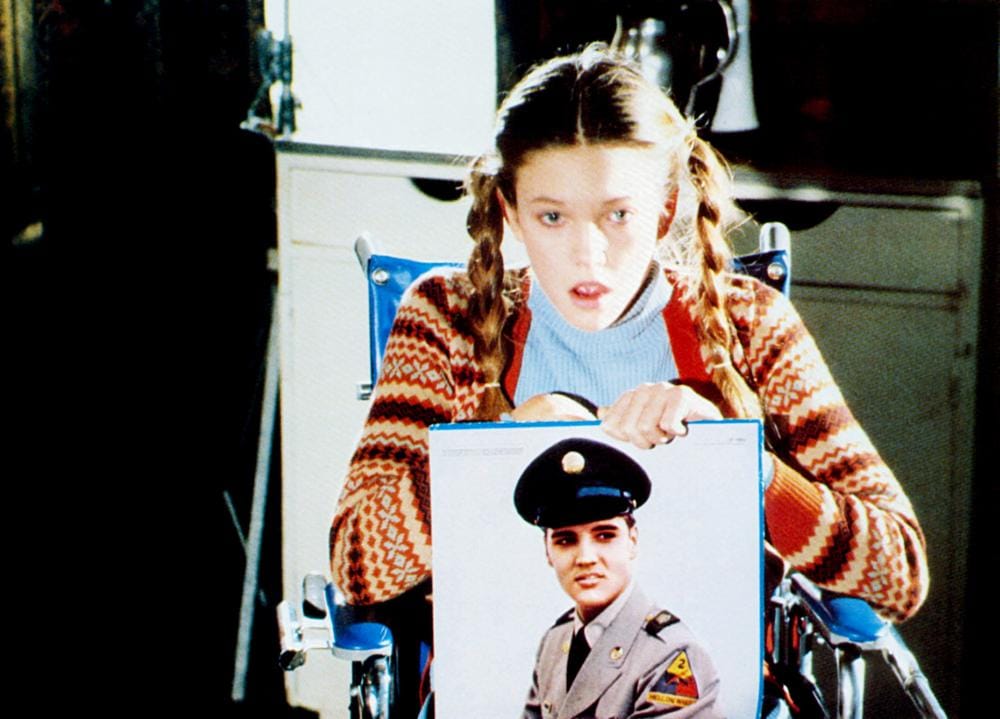
It’s almost exactly forty-five minutes in that the film introduces the idea that Karen is obsessed with Elvis Presley, and from that point on, he’s basically the third star of the film. Karen tells Lena why he’s so important to her, and Lena helps Karen write her first letter to Elvis. It’s important to Karen that she do it herself, and at first, it gives her something to focus on, something to pour her energy into. When Elvis doesn’t respond, though, it sets Karen back dramatically. John Barry’s entire score is built around Elvis melodies, with “Love Me Tender” getting a particularly vigorous workout, and again… it’s shameless. Director Gus Trikonis, best known for his onscreen role in West Side Story, actually worked with Elvis on his legendary ’68 Comeback special as a dancer, and it’s clear that Elvis made an impression on him. Not only did he make this film, but he also directed Elvis and the Beauty Queen, a TV movie that was released in 1981. When the first letter from Elvis finally arrives for Karen and she reads it to Lena, it’s hard not to be moved by just how much that simple kindness means to this girl. It’s only in the film’s final twenty minutes or so that he and Karen start to correspond, and it’s easily the sweetest material in the movie. Lane radiates with the simple joy of being seen by someone, and she makes it land even when the filmmaking doesn’t.
The film ends with a little bit of blunt-force emotional trauma, delivered with a sledgehammer touch, and it’s hard to argue that the movie is anything but naked manipulation, end-to-end. While Lane does solid work for a teenager handed this kind of material, I can see why Raffin never quite caught on as a big screen actress. She never lands any of the big emotional punches that the film depends on, and she’s one of the primary reasons it doesn’t connect. There was a push to try to get her into the awards conversation for the film, and she ended up with both a Golden Globes and a Razzie nomination for her troubles. There is nothing theatrical about the filmmaking, but you saw this one on TV, which is where I presume most people saw it if they ever did, it probably felt just right. Columbia rolled the film out in the spring of 1980 in some markets, including Memphis, and then tried again with an October rollout in NY and LA. They did indeed try sending Raffin to China, where she was enough of a hit to get another film with Trikonis directing set-up, but this has largely remained an occasional pop-up on cable, and viewed today, it borders on laughably insensitive at times, although overall, it’s too mild-mannered to cause any real offense.
NOVEMBER 12
Steel
Lee Majors, Jennifer O’Neill, Art Carney, Harris Yulin, George Kennedy, Redmond Gleeson, Terry Kiser, Richard Lynch, Ben Marley, Roger E. Mosley, Albert Salmi, Robert Tessler, Hunter von Leer, R.G. Armstrong, Joe De Nicola, Janet Hadland, Carole Mallory, Bea Silvern, Cynthia Songé, Susan Kingsley, Tommy J. Huff, Steve Ferry, Vernor Reich, Betty Raible, George Planco, Richard Pruitt, William Bartman, Stephen Abrums, A.J. Bakunas, Jud Chalkley, Kathy King, Jim Whittle, Charles A. Tamburro, Ray Collins, J.D. Wells, Gynn Rubin, Jay Pierce, M. James Arnett, Lydia Cornell, Tammy Kaufman
cinematography by Roger Sherman Jr.
music by Michel Colombier
screenplay by Leigh Chapman
story by Rob Ewing & Peter S. Davis & William N. Panzer
produced by Peter S. Davis and William N. Panzer
directed by Steve Carver
Rated PG
1 hr 42 mins
After a tragic accident, a legendary foreman’s daughter puts together a team to try to finish a building before project has to default.
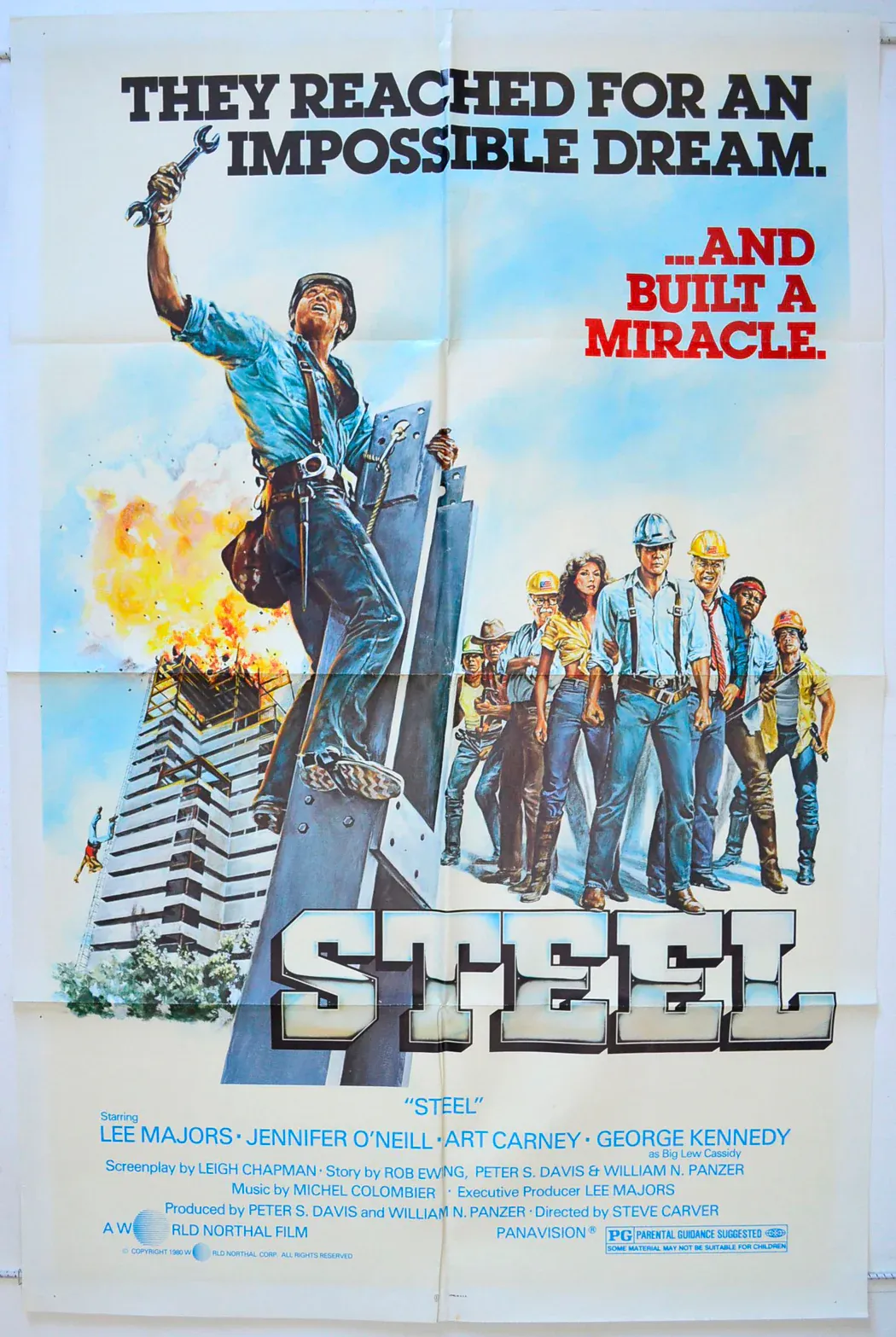
Lee Majors put a million dollars of his own money into the production of Steel, a movie that played LA under the far more exploitation-friendly title Look Down and Die! Considering what happened during the making of the film, that title feels ill-considered, but I’m not sure either title would have been the reason this one failed to connect.
The early ‘80s were a weird time, and it felt like the wall between what was a TV movie and what was a theatrical movie was getting terribly thin. Major studios were using their television divisions to crank out cheaper fare and then putting it in theaters, and there was a definite “TV movie” aesthetic that started to creep into theaters. Davis-Panzer Productions put together this film’s $4 million budget by preselling the rights to NBC, Time-Life, and HBO, and Columbia stepped in to handle theatrical distribution. They opened it overseas first, then backed out before they got to the US release. Eventually, World-Northal Corporation stepped in and picked it up for the US. The film did indeed get a theatrical release, and then basically vanished without a trace.
It’s not a bad movie, but it just doesn’t feel theatrical at all with the exception of Michel Colombier’s score, which sounds like it was written for a much more exciting film. The film opens with “Big Lew” Cassidy working on a new building with his team. George Kennedy is only in the film for a few minutes, but he’s well-cast as a tough, take-no-shit foreman. When one of his workers freezes, Cassidy goes after him, and he ends up falling to his death, and what I’m going to say next may sound ghoulish, but I can’t think of any way to write about this movie without addressing this point. When they were shooting the film, A.J. Bakunas was the stuntman who doubled for Kennedy, and the goal was to break Dar Robinson’s recently-set free fall record. Robinson set that record a number of times, and he frequently had to compete with Bakunas, who would break whatever record Robinson set. Bakunas ended up making a 323-foot fall from the top of the building where they were shooting, and when he hit the airbag, it burst, and there was no emergency support. He did massive damage to his back and his lungs and died hours later. That is a horrible, horrible tragedy, and I strongly believe no stunt person should ever die for a movie. But (and this is a seriously ghoulish “but,” I acknowledge) if you do end up in this situation and you decide to use the stunt in the film, then actually use the stunt in the film. They include some of the footage here, but it’s cut up so badly and mixed in with such obviously fake footage that it only compounds the tragedy. There’s no value whatsoever to a stunt shot this poorly, even if everyone walks away unscathed, and knowing a professional died for something this poorly shot only feels like insult on top of profound injury.
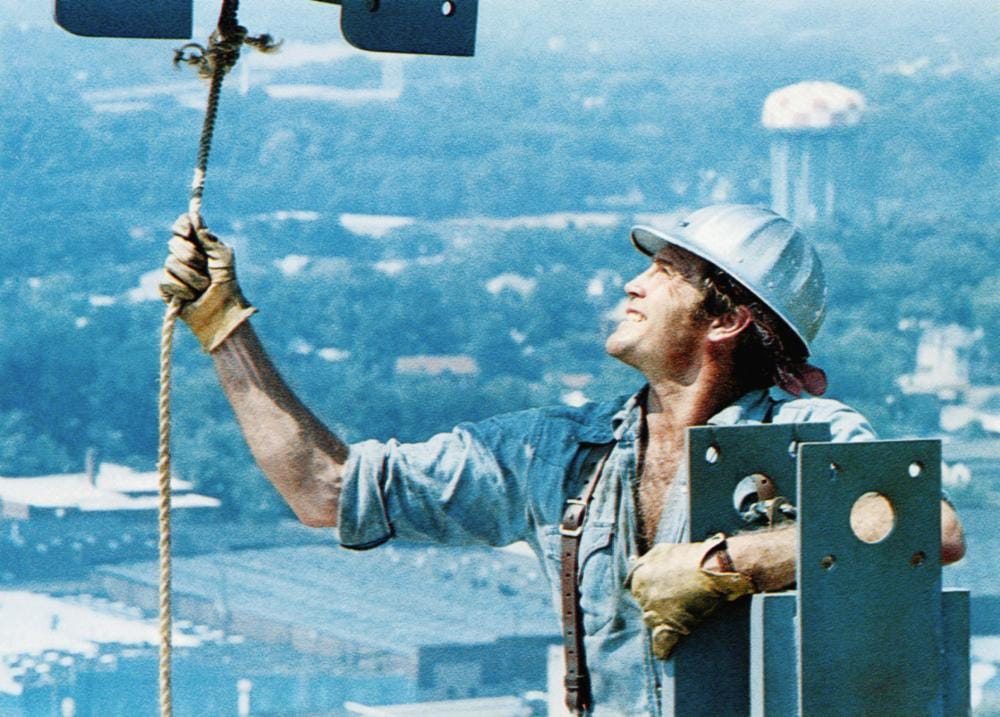
Once Cassidy dies, his daughter Cass (Jennifer O’Neill) steps in to try to finish the job, but she needs a team to pull it off. With the help of “Pignose” Moran (Art Carney), she reaches out to Mike Catton (Lee Majors), and he puts together a team of the best steel workers he can, including familiar faces like Terry Kiser, Richard Lynch, Roger Mosley, and Robert Tessier, and the whole time they try to finish the building, Cassidy’s shitheel brother Eddie and his henchman Kellin (R.G. Armstrong) try to keep them from finishing so they can take over the project. That’s pretty much it. Mike’s got a fear of heights, and if you assume that means he’s going to have to climb a very high something under dire circumstances, congratulations, you’ve seen a movie before. All of the talented character actors help make this familiar fare watchable, and Steve Carver does an entirely okay job of keeping things moving. It’s a movie that will not surprise you in any way, but it feels like it also won’t disappoint you if you give it a try. It’s pretty much exactly the film it promises, and except for one quick flash of bare breasts, it would be right at home on a Saturday afternoon basic cable channel.
DECEMBER 12
There Goes The Bride
Tom Smothers, Twiggy, Martin Balsam, Sylvia Syms, Michael Witney, Geoffrey Sumner, Graham Stark, Hermione Baddeley, Toria Fuller, Margot Moser, John Terry, Jim Backus, Phil Silvers, Broderick Crawford, Pedro Gonzalez Gonzalez, Carmen Zapata, Steve Franken, Aurora Coria, Philip Faversham, Martin Crowther, April Cloud, Arthur Ballard, John DiSanti, Mal Jones
cinematography by James Devis
music by Harry Robinson
screenplay by Ray Cooney and Terry Marcel
based on the play by Ray Cooney and John Chapman
produced by Ray Cooney and Martin C. Shute
directed by Terry Marcel
Rated PG
1 hr 28 mins
On the weekend of his daughter’s wedding, a man begins to hallucinate a wise-cracking flapper, leading to genuinely unhinged mayhem.

There are any number of reasons I might miss a film when putting this project together, even after spending almost six years working on it so far. In this case, I missed a movie in December of 1980, and it appears that the director of Hawk the Slayer made a whole slew of films in a row and they all came out right on top of each other. I only learned this while writing about Hawk the Slayer. As it turns out, even as Hawk the Slayer was making its debut on TV in the UK in December of 1980, Marcel had a film in theatrical release in the U.S., and I had no idea. It played theaters in the UK in July of 1980, but this is all about American release dates, so I’ll be inserting this into the permanent archive version of December 1980.
I like that Terry Marcel is billed as “Terrence Marcel” here. I presume he reserves that for his really special films, like when Francis Coppola throws the “Ford” into the middle of his name ‘cause he feels extra-pretty. This adaptation of a deeply creaky stage play by Ray Cooney, is genuinely bizarre, an ultra-cheap and deeply ugly movie that barely qualifies as “filmed entertainment.” It opens with a psychiatrist played by Phil Silvers interviewing Graham Stark as a man who used to be the headwaiter at a high-end hotel in America until he had a nervous breakdown for reasons that will be explained in a movie-length flashback that is entirely devoid of anything even accidentally resembling a laugh. Stark is best known for his English comedy work, and when A Shot in the Dark was a massive international hit, I would argue Stark was as much a part of the film’s comedy success as Peter Sellers or Herbert Lom, and appeared in many of the Pink Panther films playing different characters. I have always been delighted by his delivery of “Zat is not… mah… dog” in The Pink Panther Strikes Again, for example. Stark had a long career as a scene-stealer, so it gives me no pleasure to report that he is deadly unfunny here. Considering Tommy Smothers is even less funny, one has to assume that at least part of the blame falls on Marcel, whose surprisingly long career is mainly low-grade action junk. He does not seem to have any aptitude for comedy, whether in the staging or the shooting or the cutting. I’m not sure he even understands he’s making a comedy. It’s frantic, sure, but to no avail.
Smothers plays Timothy Westerby, an ad executive who has two major deadlines looming. He’s got to come up with a new ad slogan for Mr. Perkins (Jim Backus), his biggest client, and he’s got to throw the wedding for his daughter Judy (Toria Fuller), and that means entertaining his new in-laws, including the irascible Elmer Babcock (Martin Balsam). That would be enough plate-spinning for most farces, but There Goes The Bride decides to throw in a sudden onslaught of schizophrenia as Westerby starts hallucinating his dream girl, Twiggy, playing a 1920s flapper for some reason. The more he insists she exists, the crazier the weekend gets, and Graham Stark keeps getting caught in the crossfire, eventually leading him to a complete mental collapse. It took me three different viewings to get through this one, so I understand how he feels.
December 19
My American Uncle
Gerard Depardieu, Nicole Garcia, Roger Pierre, Nelly Borgeaud, Pierre Arditi, Gerard Darrieu, Philippe Laudenbach, Marie Dubois, Henri Laborit, Bernard Malaterre, Laurence Roy, Alexandre Rignault, Veronique Silver, Jean Lescot, Genevieve Mnich, Maurice Gaultier, Guillaume Boisseau, Ina Bedart, Ludovic, Salis, François Calvez, Stephanie Loustau, Monique Mauclair, Damien Boisseau, Gaston Vacchia, Bertrand Lepage, Jean-Philippe Puymartin, Catherine Frot, Valerie Dreville, Brigitte Rouan, Max Vialle, Yves Peneau, Jean-Bernard Guillard, Laurence Fevrier, Charlotte Bonnet, Jean Daste, Anne-Christine Joinneau, Sebastien Drai, Marjorie Godin, Liliane Gaudet, Isabelle Ganz, Maria Laborit, Albert Medina, Laurence Badie, Cerene Ferrey, Sabine Thomas, Catherine Serre, Jacques Rispal, Helena Manson, Serge Feuillard, Gilette Barbier, Dominique Rozan, Michael Muller
cinematography by Sacha Vierny
music by Arie Dzierlatka
screenplay by Jean Grualt
based on the writings of Henri Laborit
produced by Philippe Dussart
directed by Alain Resnais
Rated PG
2 hrs 5 mins
“The being’s only reason for being is being.”
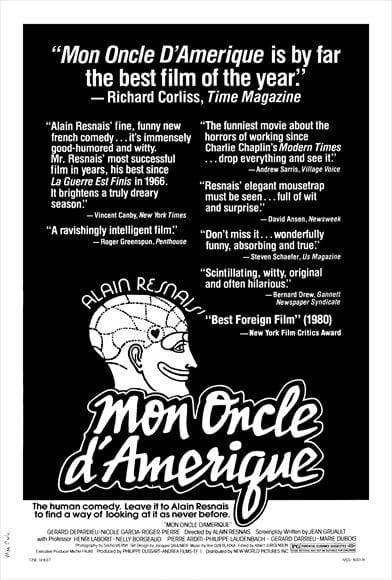
When America started to fall in love with international cinema as an arthouse alternative to Hollywood fare in the ‘50s and ‘60s, the movies that were the biggest hits were the ones that either offered up something completely exotic or the films that felt like they played new variations on familiar forms. While some of the more experimental films were greeted with awards or strong reviews, they were less successful financially than their reputation might suggest. I always assumed Hiroshima mon amour and Last Year at Marienbad were big hits here, but Alain Resnais did not have a genuine American “hit” until the December 1980 release of this film, which seems wild since one of the strangest things he ever made.
It is not often I find myself confounded by an attempt at writing a summary of a movie or describing what a film is about or how it tells its story, but My American Uncle is indeed confounding. In this case, after writing fifteen different versions of the synopsis, I opted to just run one line that feels like it’s as close to an encapsulation of everything the movie says as possible. It’s a film about human behavior and how it relates to animal behavior. Sort of. It is an attempt to take a scientist’s work and somehow illustrate it through narrative. It feels like an attempt to fashion new film language even as you’re making a movie, like laying track in front of a train that’s already moving. It is experimental but also somehow playful, and while I’m still not sure I can totally get my head around everything the movie’s doing and how it’s doing it, my second viewing of this one was more fun than the first one, and it feels like a movie that not only invites but rewards repeat engagements with it.
Henri Laborit is the neurologist/philosopher (there’s a combination) whose work started Resnais thinking about the underlying ideas that drive the film. It was Laborit who first approached Resnais about working on a short documentary together. When that didn’t happen, they continued talking, and much of their conversation focused on ways to blend documentary and narrative filmmaking. Jean Gruault (who did spectacular work on Two English Girls, The Story of Adele H., and, of course, Jules & Jim) was brought in as screenwriter, and together with Resnais, he read pretty much everything Laborit had ever published, looking for anything that might spark narrative threads. It is a film where the screenplay and the editing and the cinematography and the acting are all pushing boundaries, and not all in the same direction. It can be dazzling and surreal, but it is also full of moments and ideas and characters that feels grounded and universal.
We follow three characters, Rene Ragueneau, Janine Garnier, and Jean Le Gall, all born at the same time, each of them living in a very different version of France. Right away, Resnais starts deconstructing each of them in terms of childhood and upbringing and influences in dizzying montage fashion before testing their basic evolutionary responses to see what they’ll do in the face of stress. At the same time, we watch experiments involving rats that are designed to test these same responses, and the way the film is built, it is clear how little distance there is between what we’re seeing in each case. It is a film about fight or flight and the way those things can be impacted or inhibited by conditioning. We see how Jean (Roger Pierre) is raised middle-class, how and why he marries his childhood girlfriend, how he plays at politics in his writing. We see how Rene (Depardieu) is a farmer by birth who rejects everything he knows to become an industrial executive. And we see Janine (Garcia) embrace an artist’s life as a refutation of her parents’ more proletariat beliefs.

The film takes a while to start threading each of these three storylines together, but it’s not really a film about plot. The way Laborit (who appears in the film as himself, often addressing the camera directly) is used makes it clear that we’re meant to dig into each of these characters as a type, an illustration of one kind of social programming. It is a film about behavior, and Resnais and Gruault want to know why these characters do what they do just as much as Laborit wants to know why his rats do. They contradict their upbringing and their beliefs at times, and Resnais uses archival footage of French screen legends Jean Marais, Jean Gabin, and Danielle Darrieux as punctuation and commentary in a way that feels both funny and, at times, almost surgically savage. It’s clear that media is just one more thing that Resnais feels goes into teaching us how to behave. We are what we have watched, whether in our homes or our churches or our schools or, yes, on our screens. The title of the film remains a dangling thread even after you’ve seen it, since everyone refers to an American uncle of theirs at least once, and it feels like that is part of the point. We are all playing roles in our lives that are cast for us, and we may push against those roles, but even that will unfold according to programming. We all serve as our own worst enemies at times for reasons that we could never articulate, and this film does its best to investigate exactly that. Why are we the way we are? How much control do we ever truly have over ourselves? Can we reject our programming? Do we have to be the sum total of the things that are poured into us by our parents, our schools, our churches, our media? Do we ever even really understand what makes us the way we are?
Albert Jurgenson’s editing here is brilliant, and he manages to bridge the filmmaking by Resnais and the writing by Laborit in a way that illuminates both. The film was nominated for Best Original Screenplay at the Academy Awards in 1981, and that is a bold choice, but a recognition of just how daring and singular this movie is. The film did terrific business in France when it opened, and it was a genuine commercial breakthrough for Resnais in America. Critics loved the film, and audiences were consistently surprised by how easy it was to engage with, even if it was nearly impossible to describe afterward. It is one of my favorite kinds of movies, a movie that will leave you spinning through not just reactions to what you’re watching, but involuntary and inevitable replays of moments in your own life where your own behavior was out of control or inexplicable. It is a film that expects nothing less from a viewer than total attention, and it remains cutting-edge even now.
1981
MARCH 20
Amy
Jenny Agutter, Barry Newman, Kathleen Nolan, Chris Robinson, Lou Fant, Margaret O’Brien, Nanette Fabray, Lance LeGault, Lucille Benson, Jonathan Daly, Lonny Chapman, Brian Frishman, Jane Daly, Dawn Jeffory, Frances Bay, Peggy McCay, Len Wayland, Virginia Vincent, Norman Burton, Otto Rechenberg, David Hollander, Cory ‘Bumper’ Yothers, Alban Branton, Ronnie Scribner, Michelle Downey, Carson Sipes, Diana Boyd, Flavia Fleischer, David Jacob Weiss, Oscar Arturo Aguilar, Kevin van Wieringen, Seamon Glass, Nancy Jeris, Randy Morton, Lance Gordon, John Arndt
cinematography by Leonard J. South
music by Robert F. Brunner
screenplay by Noreen Stone
produced by Jerome Courtland
directed by Vincent McEveety
Rated G
1 hr 40 mins
A woman leaves home to help teach deaf children to speak in an effort to leave behind a personal tragedy.
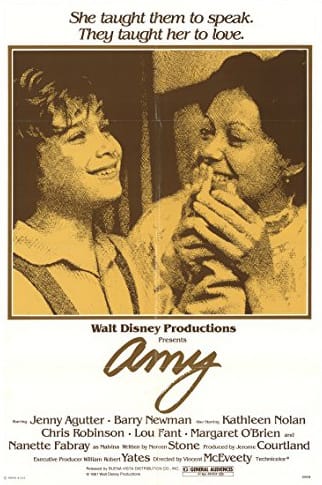
We’re still early in the decade, but we’ve already discussed the troubles Disney was facing as a studio several times at this point. It bears repeating… this was a studio in crisis.
At this point, the primary focus of the company was the upcoming opening of EPCOT Center and the early development process on Tokyo Disneyland. Their animation division had just hit a wall when a whole group of animators, led by Don Bluth, left the studio during the production of The Fox and the Hound, and they were scrambling to figure out how to move forward after barely finishing that one. And despite flirting with more adult fare, the live-action division was just shambling from one misfire to another with no point of view about what a modern Disney looked like. The only live-action films Disney produced between 1977 and the end of 1981 that I like at all are Popeye and Dragonslayer, and those were both co-productions where someone else was doing the heavy lifting on the creative end. Everything else is formulaic and painful and various degrees of cheesy. Measured by that standard, Amy looks perfectly fine, I suppose, but it’s hardly some hidden gem.
Vincent McEveety directs, and at this point, he’s pretty much Disney’s primary in-house guy. He’s coming off Herbie Goes to Monte Carlo, The Apple Dumpling Gang Rides Again, and Herbie Goes Bananas in a row, and when Disney ran into trouble on Watcher in the Woods, McEveety was one of the people brought in to help fix the unfixable film. When he was hired for Amy, it was still scheduled to be a television film called Amy on the Lips. When the film was finished, Disney decided it was too adult for a television audience and they pushed it to the theatrical division to figure out. Disney gave the film a decent-sized push in March and seemed to genuinely believe in it.
In some ways, it reminds me of Touched by Love. That film was shot at a real school for children with disabilities, using many of the actual students and teachers, and Amy does the same thing with the California School for the Deaf in Riverside, California. Almost every one of the children in the film was an actual student from the school, and one of the main teacher roles was played by an actual teacher from the school. This time, though, the focus is far more on the teacher than on the student, and Amy feels far closer to the model of The Miracle Worker. Jenny Agutter plays Amy Medford, a teacher in 1913 who is hired to work at a small school in the Appalachians. From the moment she joins the school, she’s controversial because she actually believes deaf children can be taught to speak, something that was largely believed to be impossible at the time. There’s a mystery about why Amy left her home in Boston, especially once it’s revealed that she is married and that her husband has no idea where she went. Even as Amy starts to see results, there’s something sad about her, and she resists a growing attraction to a doctor (Barry Newman) who comes to take care of some of the children.
It’s a fairly low-energy affair, although there’s one big scene involving a train and one of the kids. Eventually, Amy’s husband comes looking for her, and things are wrapped up in such sudden, startling fashion that you might feel like you missed something or there’s something wrong with your copy of the film. It feels like it was directed quickly and on the cheap, and it is frankly amazing that Disney thought this was good enough for a theatrical release. The notion that this was too adult for their television division is insane. Yes, the scene on the train tracks ends sadly, and Amy’s backstory turns out to also be quite sad, but Disney’s always sprinkled a little trauma into even their sunniest films. Agutter’s not bad in the film, but that flinty quality that makes her so interesting also makes Amy hard to warm up to as a character. Well-intentioned as it is, Amy also feels like a bit of a wallow, something that is always a danger in these types of films. Movies like this and Touched by Love use people who are genuinely living through these experiences as wallpaper while they have actors playing their disabilities sitting right in front of them. It is at least unsettling and insensitive, and at worst, callous and even cruel. There’s little to like here, and even in the midst of one of the studio’s lowest points, this feels particularly forgettable.
MAY 15
Cafe Express
Nino Manfredi, Adolfo Celi, Vittorio Mezzogiorno, Luigi Basagaluppi, Silvio Spacccesi, Gerardo Scala, Lina Sastri, Marisa Laurito, Vittorio Marsiglia, Marzio Honorato, Giovanni Piscopo, Clara Colosimo, Maurizio Micheli, Tano Cimarosa, Italo Celoro, Leo Gullotta, Nino Vingelli, Ester Carloni, Nino Terzo, Gigi Reder, Concetta Barra, Antonio Allocca, Vittorio Caprioli
cinematography by Claudio Cirillo
music by Givanna Marini
screenplay by Nanni Loy & Elvio Porta & Nino Manfredi
story by Elvio Porta & Nanni Loy
produced by Nicola Carraro and Franco Cristaldi
directed by Nanni Loy
Not Rated
1 hr 40 mins
A man who sells coffee illegally on a night train in Italy spends one long evening dodging conductors, dealing with his son, and foiling some robbers.
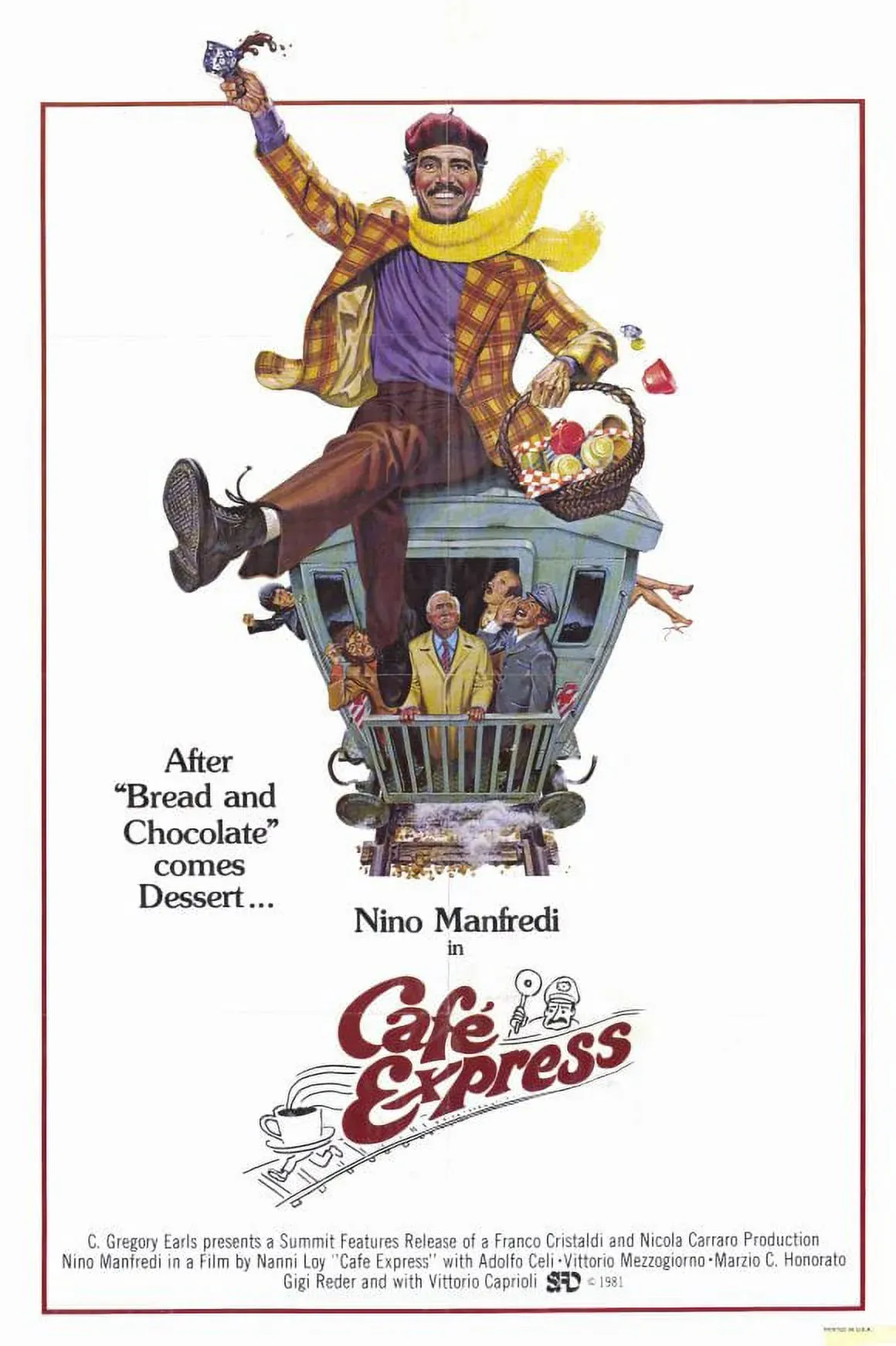
I am completely unfamiliar with the work of Nanni Loy, an Italian filmmaker who worked from the ‘50s to the early ‘90s, and I probably would not have included this film in this project if not for Quentin Tarantino, who programmed this as part of his Video Archives Podcast’s first season. That would have been a shame, too, because Cafe Express is a charming, cleverly-constructed slice of social realism comedy. There’s no way I would have paid any attention to this in a theater in May of ’81, but it feels like a genuine discovery to be introduced to it now.
Nino Manfredi, the star of the film, was a major Italian star, and his international hit Bread and Chocolate is one of the best-known examples of the commedia all-italiana school of filmmaking. This is an era of around twenty years in which filmmakers used comedy to dig into the very real social issues that the country struggled with. These are films that are unafraid to discuss ideas like divorce and the Catholic Church and the economic reality of Italy during the post-WWII reconstruction, somehow mining laughs from subjects that American films were often still afraid to deal with. That era was coming to close when Nanni Loy made this film and Hot Potato, and collaborating with Manfredi makes Cafe Express feel like a sort of goodbye to this style of film. Originally, both films were meant to be part of an anthology movie, but he decided to develop each one separately, and I’m glad he did. Cafe Express is rich enough to stand on its own, almost serving as an anthology of short films in a way.
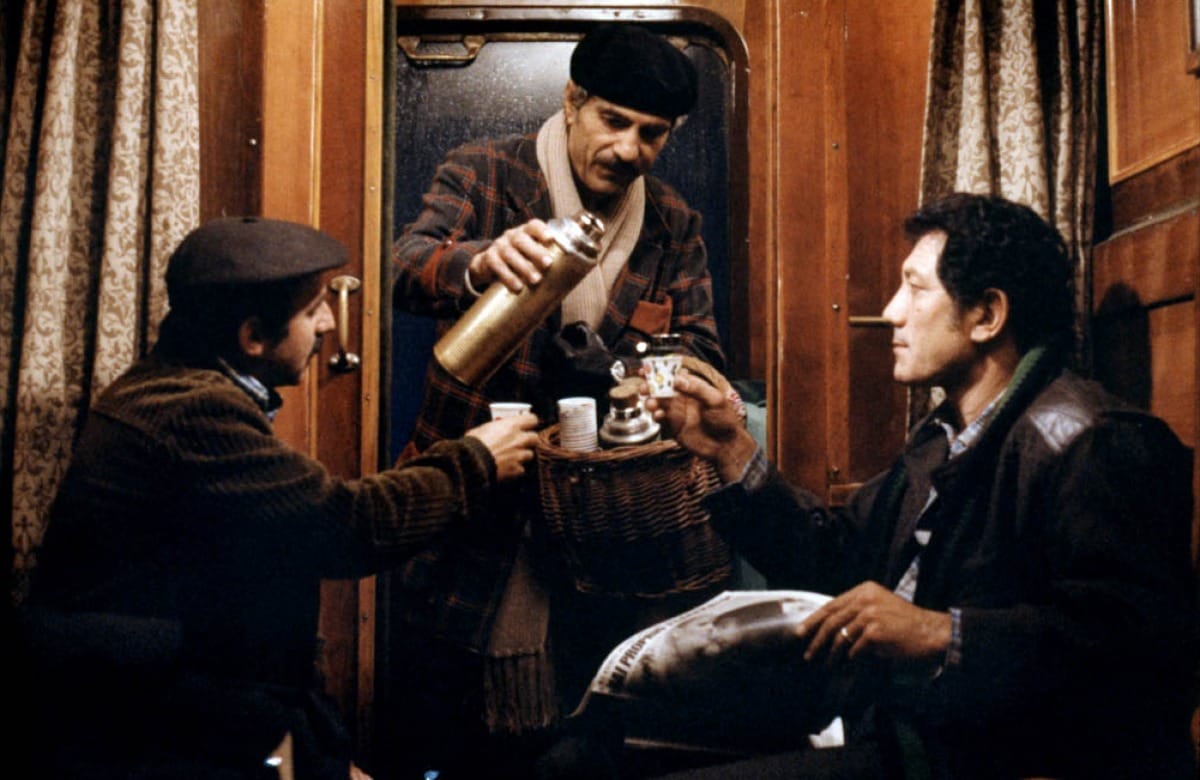
Manfredi stars as Michele, a man who rides the train back and forth between Naples and Vallo, selling coffee, hot milk, and cappuccino. He’s not affiliated with the train service and what he’s doing is technically illegal, so Michele has developed an entire system to keep himself in business and out of trouble. One night, a group of conductors are tasked with finding Michele and stopping him permanently, and of course, this is the same night that his son (long institutionalized for his congenital heart defect) has managed to escape and stowaway and that a group of thieves have targeted the train, so it’s going to be a madcap night of near-misses and carefully constructed comedy escapes, and it all serves as a lovely showcase for Manfredi. Michele’s the kind of vendor who can quickly read everyone he deals with, customizing not only his sales pitch but also his personality for each person, giving them exactly what they need in a way that goes deeper than refreshment. Every car offers a chance for a totally different vignette or tone, and way more of them work than don’t. In particular, Michele’s relationship with his son Cazzi (Giovanni Piscopo) is a delight. The film gets more pointed and prickly as the long night gives way to early morning, and the film’s barely restrained fury at economic disparity, and the film builds to a punchline that suggests Cazzi has learned far more from his father than Michele ever suspected. It’s a very simple film, overstuffed with small pleasures, and as fine an example of its genre as you’re going to find.
NEXT TIME
Oh my god! We really did it! And now that we’ve gone back and updated everything… no more boners! Ever!
I’m going to do one more month from 1985 before we jump back to the 1981 schedule. It was so much fun to write May of 1985, which was the rev-up to the summer season, but I’d like to do one full month of that iconic summer line-up before I head back to what will be one of the most punishing months of the entire decade-long project. You’ll see what I mean in February when we talk about October 1981. And then we start zig-zagging back and forth, one month at a time.
But wait!
There’s one more way I’m going to mix things up!
Now that I have every single potential title in my Plex server, I’m going play ‘80s Roulette once a week as a writing exercise. I’ll go to my ‘80s library, hit the shuffle button, and then I’ll watch and review whatever title comes up, no matter what year it’s from. The only way I’ll reshuffle will be if a title comes up that we’ve already done. It’ll be a fun way to keep an element of chaos in the mix, one more way to keep this project exciting for me. Look for those every Friday starting this week.
That’s what you can expect in 2025, so thank you for your continued patronage. If you know someone who would love this newsletter, why not get them a gift subscription? It’s one of the best ways you can help me keep things going long enough to get to the eventual finish line. I appreciate your time and your attention, and I hope this next year is the best one yet for this newsletter.