
The Hip Pocket #24: DO THE RIGHT THING
We bring this series back with the best film of the '80s
We all have movies we love.
Some of them are great movies. Some of them are terrible movies. Love does not care. Love is unreasonable. Love is blind. We love what we love, and the louder you love it, the better.
One of my favorite things is sharing a film I love with someone. Even if they don't love it the same way I do, that experience imparts something about you to that person. When you share something you love, you are sharing a part of yourself, and there is nothing more vulnerable or personal than that.
I don't think of these movies as the canon or the official library or anything that formal. These are all just movies I keep in my hip pocket, movies I've filed away as part of my own personal ongoing film festival as worthwhile and notable.
This is an ongoing list, one without an ending. This is The Hip Pocket.
Do The Right Thing
Danny Aiello, Ossie Davis, Ruby Dee, Richard Edson, Giancarlo Esposito, Spike Lee, Bill Nunn, John Turturro, Paul Benjamin, Frankie Faison, Robin Harris, Joie Lee, Miguel Sandoval, Rick Aiello, John Savage, Samuel L. Jackson, Rosie Perez, Roger Guenever Smith, Steve White, Martin Lawrence, Christa Rivers, Leonard L. Thomas, Luis Ramos, Steve Park, Frank Vincent
cinematography by Ernest Dickerson
music by Terence Blanchard
screenplay by Spike Lee
produced by Spike Lee and Monty Ross
directed by Spike Lee
Rated R
2 hrs
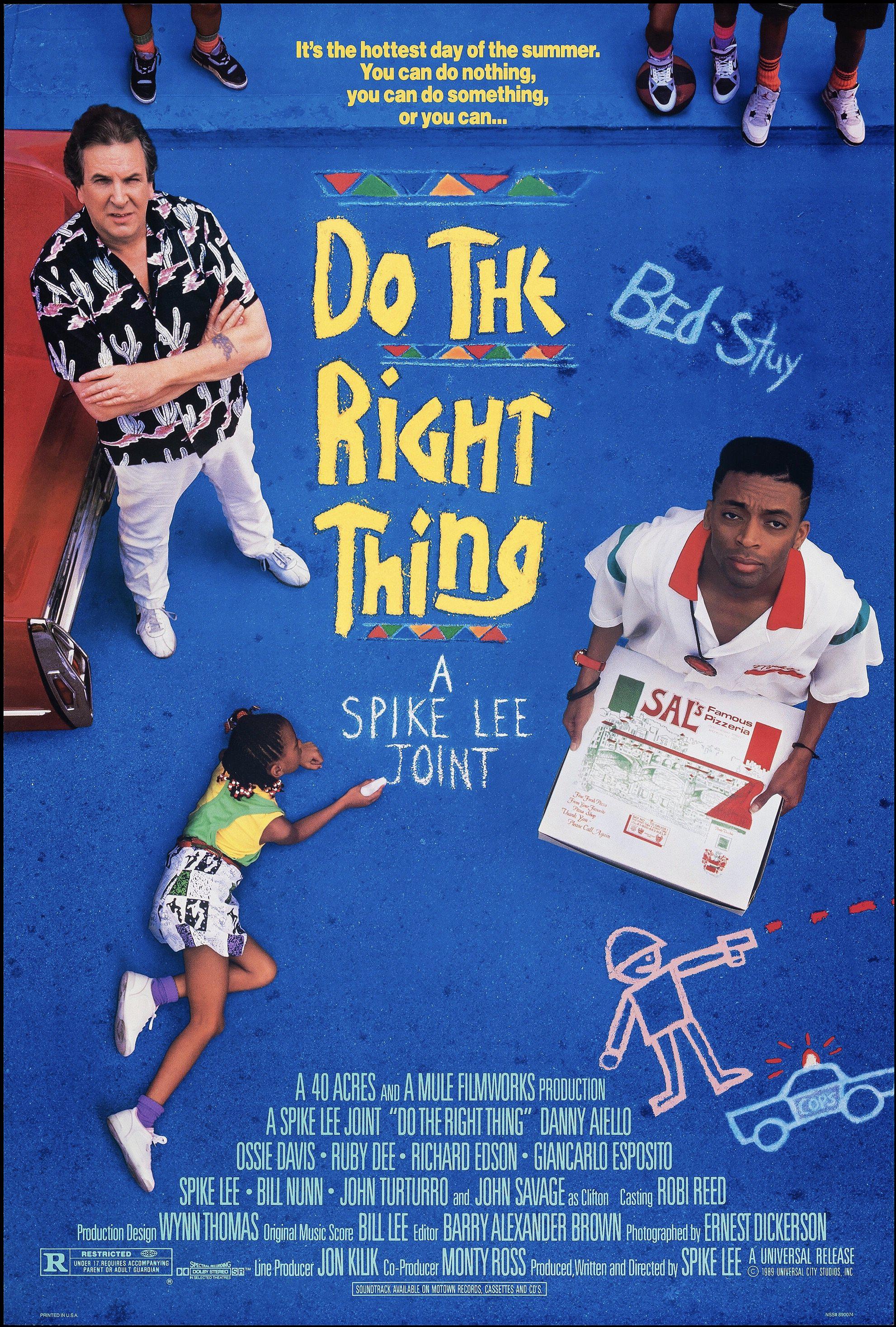
On the hottest day of the summer, tensions flare in a Brooklyn neighborhood with everyone’s attention focused on Sal’s Pizzeria, the Wall of Fame, and a young man named Radio Raheem.
It may be a cliche to say so, but the dialogue in Spike Lee’s towering (and infuriating) Do The Right Thing is like music, and I love to listen to the film as much as I love watching it. Maybe even more.
When I first moved to Los Angeles back in 1990, I had been here for about two days when I saw a notification for an event that was being held at the Samuel French bookstore on Sunset Blvd. Spike Lee was doing a book signing to mark the release of Mo’ Better Blues, and I decided there was no way I was missing it. My buddy and I drove over the hills from where we lived, found the bookstore (these were the days of relying on your Thomas Guide for everything), parked nearby, and then walked over to make sure we were there the moment the store opened.
Keep in mind, the signing wasn’t supposed to happen until 6:00 that evening. But I pictured this crazy throng of thousands of people all clamoring to get Spike to sign their books, and I wasn’t going to get shut out. Nope. No way. When the store opened and I asked the employees where to line up, they looked at me like I was a crazy person. They recommended coming back a few hours before the event. When I wouldn’t budge, they finally found a place in the side alley for me and declared that the start of the line. I stayed there all day, and by the time it was actually supposed to start, there were a few hundred people in line. And there I was, right at the head of that line, all 6’2” of big goofy white kid, and I had my copies of the books for Mo’ Better and Do The Right Thing all ready to go.
There were camera crews there to shoot a little footage of the event, and when they were getting ready to open the doors, a few people came out to pick someone to be the first person on-camera to get their book signed.
I did not handle this news well.
To be clear, I asserted at top volume that this was BULLSHIT and that I had been there all day and NO WAY IN HELL was anyone else walking in there first just because they were demographically preferable. The people in charge of the event quickly realized that I was a lunatic with no compunctions about bellowing my grievances, and they told me I would be the first one in.
By the time I got inside, it seemed like Spike Lee had already been prepped on what happened, and he watched me with that bemused “what kind of nonsense is this?” smile that is his trademark as I approached the table. “So… they tell me you waited all day because you had a question. What’s your question?”
“In Do The Right Thing, when Radio Raheem does the whole right hand/left hand thing from Night Of The Hunter, is that Radio Raheem paying tribute to Robert Mitchum, or is that Spike Lee paying tribute to Robert Mitchum?”
Lee laughed, and he kept laughing as he answered me. “Radio Raheem doesn’t know who the fuck Robert Mitchum is.”
I got to chat for another minute or so while he signed both books, but honestly, getting the laugh out of him was the main thing. It was just important to me to be able to say what I said to him when he handed me the signed books. “You make filmmaking feel possible,” I said, and I meant it. As much as anyone else in my first 20 years, Spike Lee made filmmaking feel like something that was obtainable by anyone, and before I have any opinion about him as a black filmmaker, I have to acknowledge my overwhelming respect for him as an independent filmmaker.
If you ask any young white guy after about 1995 why they wanted to get into film, chances were you’d hear about either Quentin Tarantino or Kevin Smith or maybe even Robert Rodriguez or Richard Linklater. There was an explosion of young talent at the same time with very strong voices and the success stories that the mainstream enjoyed the most were the ones with the big easy narrative arcs. He was a video store clerk first and he watched every movie in the store and that’s how he learned to make movies! He worked in that real convenience store and his friend worked in that real video store and they just started writing and making it because that’s what they had! He sold his organs to make his movie! Whatever the story, it gave these directors a sort of superhero origin story, and it also played up the idea that they did it with nothing. They made it happen outside the system, and the system had to pay attention as a result.
Before those guys, though, Spike Lee served as a hands-on example of how you could realistically hope to make a feature film that people might actually see. Every film he released, he also released a book that included the script and his diaries and an explanation of how things came together. They were brutally honest books, and Spike did not always look like the hero in the stories he told. He did, however, look like a filmmaker who knew how to hustle to get his work produced, and I read and re-read his first two books, absorbing them during my last few years of high school. I think I liked the books more than the films, but I admired the rowdy energy of the work he did, and I was excited to see what he’d do next.
What makes Do The Right Thing the special one? What makes this the movie that jumps out of his filmography as the perfect expression of who he is as a filmmaker?
I’d argue that most filmmakers have that one moment where they have a combination of the right kind of hunger, just enough experience to really know what they’re doing, and the energy to burn supernova-hot long enough to put it all together. That’s when you get a movie like Boogie Nights or Taxi Driver or Pulp Fiction. That’s when you get the most distilled and pure version of a filmmaker’s inner voice.
I thought She’s Gotta Have It was a promising start more than a great movie, and School Daze felt sincere and energetic, but it didn’t quite land the various punches that Lee was throwing. He was starting to become a brand simply as a pop culture figure, with Spike Lee and Miles Blackmon merging into his public persona. And, like I said… those books meant a great deal to me.
When Do The Right Thing came out, it arrived with some Cannes hype in tow, and I was excited to see it. Any movie that made noise at Cannes would go onto my checklist of “things I have to see,” and thankfully, in this case, it was a very quick turnaround. Cannes was in May, and the film opened in the US at the end of July. As soon as it did, I rushed to see it.
Honestly? I hated it the first time.
Actually, that’s not strong enough. I didn’t just hate it. I hated everything about it. It bothered me. It set me on edge. I felt attacked and irritated and confused when I walked out at the end of the film. I was angry about it.
I was 19. While I like to pretend that the person I am today is the person I have always been, that’s ridiculous. Like anyone else, I am the cumulative impact of all the things I’ve done, seen, or been exposed to, and the longer I live, the more I (hopefully) evolve. At 19, I thought of myself as incredibly socially progressive. Radical, even. I was not. Despite all the reading I’d done, I was still very young, and I did not particularly practice what I preach. I had a very white upbringing. The places we lived, the schools I went to, the churches we attended… none of it felt like it was designed to be exclusionary, but it was. I was a sheltered suburban white kid from the mean streets of Tampa. I did not think of myself as racist or sexist or much-of-anythingist. But, man, I could get defensive if I got poked about my beliefs, and a lot of the logic that I believed in at that point strikes me as shallow and embarrassing now. It’s strange, because sometimes I’ll see someone who is supposed to be a mature adult, and they’ll be spouting something that I would have said or done during my pre-driving days in junior high, and it makes it seem like they just stopped developing at a certain emotional age, happily and proudly stuck there.
That summer, I was working at a store called Rent-A-Movie. We were right down the street from Blockbuster, but we were a locally-owned chain, and we were determined to be the better store. I was a manager, and I had a pretty sharp staff of people. I hired a friend of mine named Jeff, and the night after I saw Do The Right Thing, I was at work, and Jeff mentioned that he had seen it, too. He’d loved it, though, and he was shocked by my reaction. We started talking about it, and a few things became apparent quickly. First, irritated or not, I had memorized giant swaths of the dialogue, as had Jeff. Second, the emotional reaction I had was no accident. Third, I didn’t hate the film at all. I hated what it made me feel in places, but I certainly didn’t hate the film.
Jeff and I saw it together a few days later, and at that point, it was just like a switch flipped. The second time through, I was watching each of the characters in the neighborhood, enjoying the way Spike and his actors filled in the corners of the frame with that terrific parade of supporting figures. The comparison I made to it after seeing it a few more times, was The Sorcerer’s Apprentice. Over the course of this one long hot day, more and more characters get caught up in this rising frenzy that’s been set in motion unconsciously by the smallest of actions, until the film finally erupts. The difference, of course, is that in Do The Right Thing, there’s no way to stop what’s coming, and instead of resetting everything with no consequences, there is an eruption that changes things permanently for the people involved. The moment Mookie throws that garbage can through that window, Do The Right Thing takes us into emotional territory largely uncharted in American cinema, and there’s no going back. Spike Lee famously changed the ending of the film to make it a more ambiguous final moment between Sal and Mookie, and I think he had to. You can’t just have Sal show up the next morning and say, “Well, I learned something, and I think you were right to throw that, Mookie.” No matter what happens to these people, it’s going to take some time for those events to make sense to them, and the film’s real ending is true to that idea. The title of the film is designed to make you ask a question, and then the actual text of the film refuses to give you any easy version of that answer. The anger I felt the first time I saw the film was because I didn’t like what I saw in the mirror that is the movie, and not liking what I saw was about me… not the movie.
The reason I disliked Do The Right Thing so much when I saw it was because Spike Lee had my number, and I hated the feeling of being called out about what I see as pretty significant weaknesses of character.
The real beauty of the movie is that even as it calls you out, it calls everyone out, and it makes the point that we all have trouble seeing past the end of our noses. There’s a montage in the middle of the film where we see one person after another staring right down the barrel of the camera and rattling off long strings of racist slurs. Mookie, Spike’s character in the film, is the first one up.
Dago, wop, garlic-breath, guinea, pizza-slinging, spaghetti-bending, Vic Damone, Perry Como, Luciano Pavarotti, Sole Mio, nonsinging motherfucker.
Pino fires off the next volley, and John Turturro pours every bit of loathing and venom into it that he can. His rant is longer than what Lee wrote for him in the script, and just blistering.
You gold-teeth, gold-chain-wearing, fried-chicken-and-biscuit-eatin’, monkey, ape, baboon, big thigh, fast-running, high-jumping, spear-chucking, three-hundred-sixty-degree-basketball-dunking titsun spade Moulan Yan. Take your fuckin’ pizza-piza and go the fuck back to Africa.
And then they come faster. Luis Ramos as Stevie. Rick Aiello as Officer Long. Steve Park as Sonny, the Korean store owner.
You little slanty-eyed, me-no-speaky-American, own every fruit and vegetable stand in New York, bullshit, Reverend Sun Myung Moon, Summer Olympics ’88, Korean kick-boxing son-of-a-bitch.
You Goya bean-eating, fifteen in a car, thirty in an apartment, pointed shoes, red-wearing, Menudo, meda-meda Puerto Rican cocksucker. Yeah, you!
It’s cheap, I got a good price for you, Mayor Koch, “How I’m doing,” chocolate-egg-cream-drinking, bagel and lox, B’nai B’rith Jew asshole.
One of the things I think that sequence does is deflate these insults and slurs. What a ridiculous bunch of reasons to dislike people. The resentments that are built into these insults say so much more about the person spouting them than the groups actually being insulted. These are things that people walk around thinking, these spiky little nuggets of hate, and when they let them out, they are irrational and ugly and… yeah… ridiculous. They are over the top and frothing, and sometimes, that’s what it takes for someone to get something out of their system. As I’m writing this, Twitter’s scrolling by in the background, and I saw someone quote the rapper T.I. about Donald Trump, who is evidently beefing with Snoop Dogg because this is the fucking reality we’re living in. T.I. said, and I quote, that Donald Trump is a “Lacefront Possum fur Wig wearing, Alternative fact, Atomic Dog diarrhea face ass man” who has a “fuckin’ old ass puppy piss smelling ass mouth,” and who is a real “Presidential Level Fuck Boy.” I’m guessing that once T.I. got that out of his system, he needed a nap. That’s not an insult; that’s a purging. These rants, these blasts of specific insulting hate that we trade back and forth in culture, are the earthquakes that come from the everyday business of tectonic plates grinding away on one another. In order for us to have a common society, we have to come together, and by the very nature of what that means, it’s clear that there’s always going to be some degree of friction. We can count on that. And if it was just words, that would be one thing.
It’s only when Spike cuts to Mister Señor Love Daddy (Samuel L. Jackson) that he throws on the brakes. “YO! HOLD UP! TIME OUT! TIME OUT! Y’all take a chill. Ya need to cool that shit out… and that’s the DOUBLE truth, Ruth.” In 1989, I didn’t really know who Sam Jackson was. He had one stand-out moment in Coming To America, and he’d been working since 1972. But in 1989, he was still basically booking roles like Sea Of Love, where he’s credited as playing “Black Guy.” In Do The Right Thing, Spike puts Sam right up front, and he takes to it immediately. This was the performance that put him on my radar. He is hilarious and powerful and having the time of his life, and it’s hard not to love the character. Mister Señor Love Daddy sits in his glass booth behind a microphone broadcasting 12 hours a day as “WE LOVE radio, 108 FM. The last on your dial, but the first in ya hearts.” Over the course of the day, his voice and the songs he spins are the constant glue, the binder for this neighborhood with all of these simmering resentments and unarticulated unease. He is the voice of his community in many ways, and that’s really what the film is about, at the heart of it. Spike realized he had to make this entire section of the city, this block, into something that felt absolutely real and fully inhabited. In order to do that, he couldn’t just give us one main character. He is constantly juggling in order to introduce us to everyone and in order to make sure we keep track of where everyone is and what all the tensions are that are boiling along over the course of the day.
One of the most interesting tensions in the film has to do with Sal (Danny Aiello) and Sonny, the local business owners, and the neighborhood itself. Sal and Sonny don’t live here. When their day is over, they leave. They go home. This is just where they work, and so the film poses the question: are you really part of a community if you’re just there to take money out of it? And if you are, then what are your responsibilities to that community? And what happens when you don’t live up to them?
The film is set on the hottest day of the year, and as the film opens, we see everybody starting to wake up, and we see how the heat just gets hold of you right away on a day like this one. Sal and his sons Pino (John Turturro) and Vito (Richard Edson) arrive to open up their shop and get it ready for the day. There is this crazy amount of aggression between Vito and Pino right away. Vito likes the people in the neighborhood. He’s a decent guy. His biggest problem is his brother, and his brother’s biggest problem is everyone else. If you just made a film about Sal, Pino, and Vito, that could be more than enough. It’s a strong dynamic, and it gives you lots of room to explore as a writer. Mookie delivers pizza for them, and Sal loves his place in this neighborhood. You can see it in the way he deals with Da Mayor (the great Ossie Davis) in the morning. You see it in the way he talks to Jade (Joie Lee), Mookie’s sister. He thinks of himself as playing a role here. He has fed people every day for decades, and that means something to him.
He’s got the wall of his pizza shop decorated with famous Italian-American faces, and the first crack in the day appears when Buggin’ Out (Giancarlo Esposito) is having his slice and staring up at that wall. Buggin’ Out is already itching for some sort of confrontation. You can tell from the way he enters the film. There’s some itch he can’t even define, much less scratch. He almost picks a fight with Sal about how much cheese he puts on his slice of pizza, but that’s just sort of a low-grade annoyance. It’s when he’s sitting there eating and staring up at the wall that he finally finds a focus for that low-grade constant dissatisfaction of his. “Hey, Sal! How come there ain’t no brothers on the wall?”
The real question he’s asking is, “If you are part of our neighborhood, then why do you work so hard to stand separate from us?” If Sal had included black artists and athletes on that wall, without anyone asking him to, chances are no one would have ever really thought about it. It would have felt right. It would have been a natural thing. Sal’s decision to only put Italian-Americans up is, by definition, exclusionary. And it’s his right to do that in his own business. Those walls are meant to reflect the spirit of the business that he runs. He’s serving pizza with his family, and he’s turned his Italian-American identity into something that he sells, one slice at a time. That’s how Sal sees it, and there’s nothing malicious about that. But it is absolutely exclusionary. Sal’s is meant to be an island in that neighborhood, not part of the larger whole, and Buggin’ Out feels that as a slight. Is it any wonder, though, when you listen to Pino? Turturro is every bit the virulent scumbag racist that Sal is not, and that seething anger is what really provokes Buggin’ Out. Everyone who has to deal with Pino over the course of the day has to know how he feels, and it’s somewhat disingenuous of Sal to pretend that his hands are completely clean. He raised Pino. He lets Pino talk that way to their customers and in front of their customers. Sal feels good playing the jolly older man role, and he lets Pino give voice to the ugliest sentiments that may well be simmering in Sal as well.
Again… if that’s all this movie was about, the escalating conversation between Sal and Pino and Buggin’ Out, that would probably be a heck of a movie. That’s what Lee does here better than he’s ever done it in another project. He created so many potent and dynamic relationships and storylines that it has that overwhelming messy intoxicating feeling of real life. He manages to make a day in the life of this block feel alive, with every contradiction and collision rich and full of potential. It’s the kind of writing, first and foremost, that I think few American mainstream filmmakers even try to accomplish. It’s mature and it’s confrontational and it’s profane and bold. This is a film that pushes the boundaries of what the MPAA can do with their own ratings. It’s an automatic R for language, but there are arguments to be made that a movie like this should be seen by parents and younger viewers together. The language here is meant to capture the way the world really sounds, but filtered through Lee’s particular ear. He’s like Richard Pryor. He has a great sense for the musicality of profanity. Check out the scenes where ML (Paul Benjamin), Coconut Sid (Frankie Faison), and Sweet Dick Willie (Robin Harris) sit around talking. They are unreal together. They are Lee’s greek chorus, and for the most part, they are fools, calling each other out for being fools, getting nowhere and perfectly fine with it. I love their conversations. I love when Lee cuts away to them. And over the course of the day, they get drawn into this very real simmering anger, just like everyone else. Watch the way it spreads from that first encounter between Buggin’ Out and Sal. Watch the way people are drawn into it. And then watch what happens when Radio Raheem dies.
Oh, man, we haven’t even talked about Radio Raheem yet. Bill Nunn is a perfect casting choice for the character. He’s a big guy, so there’s something physically imposing about him, but there’s also this soft boyishness about him that reminds me of the improbable combination of little boy and hardened thug that makes Ice Cube so appealing. Radio Raheem strolls around his neighborhood, providing a soundtrack for the day, and he is unchallenged in his ownership of this particular block. We see a showdown at one point that ends with an acknowledgment of respect, and that’s a huge part of what the film is grappling with. Respect. That’s what it really comes down to, right? The decision to either make the Wall of Fame inclusive or exclusive comes down to an issue of respect. Sal doesn’t respect the feelings of his customers, and as a result, it turns into a confrontation. And Buggin’ Out doesn’t respect Sal’s right to let his business be a reflection of him, and as a result, it turns into a confrontation. Radio Raheem’s constant wall of sound is almost like a test of respect. He’s daring you to challenge him. When he comes in the first time, radio blaring, Sal gets him to turn it down.
But by the time he comes in the second time, Buggin’ Out right there alongside him, things have escalated to a place where it’s a totally different act. There’s something violent about that wall of sound, and the use of “Fight The Power” as the main track he plays over the course of the day is brilliant because it’s such a striking, abrasive, new sound as a song. There are certain songs that I remember hearing for the first time specifically because they were so new that they almost struck me as noise. “Head Like A Hole” by Nine Inch Nails was one of those, and it took me three or four times to hear the music in the noise. With “Fight The Power,” there’s a beautiful cacophony, and it’s the combination of sounds gathered from old soul and r&b records with brand-new cutting-edge rap production that makes it such a new and alarming sound. It’s a case of the lyrics and the sound of the song perfectly complementing each other, and it is also a case where a film and a song so perfectly work with one another that I can’t imagine either without the other. The song was made for the film (you can read a terrific piece online by Ben Beaumont-Thomas interviewing Hank Shocklee and Chuck D about how they built the track), and it was so pinned to that particular time and place that by the end of the summer, Jeff and I had both played the song so many times that it was permanently etched onto our brains.
1989 the number another summer (get down)
Sound of the funky drummer
Music hitting your heart ‘cause I know you got soul
(Brothers and sisters, hey)
Listen if you’re missing y’all
Swinging while I’m singing
Giving whatcha getting
Knowing what I know
While the Black bands sweating
And the rhythm rhymes rolling
Got to give us what we want
Gotta give us what we need
Our freedom of speech is freedom or death
We got to fight the powers that be
Lemme hear you say
Fight the power
I loved the way the song fit on PE’s later album, Fear of a Black Planet, and I played that album far more than I ever played the film’s full soundtrack. But in the film, it is a perfect articulation of so many of the ideas that are at play in Lee’s film, while still feeling like it is worthy of its own conversation.
The song is not a call to violence, but rather an affirmation of how change is already happening and how it can be continued. It is a song that is full of positive energy, and I love the cascade of rhymes, the way the internal patterns play off of the larger rhymes. Chuck D’s vocal here is outrageous, and when I think of rap phrasing, Chuck D on this track is one of the gold standards.
As the rhythm designed to bounce
What counts is that the rhymes
Designed to fill your mind
Now that you’ve realized the pride’s arrived
We got to pump the stuff to make us tough
From the heart
It’s a start, a work of art
To revolutionize make a change nothing’s strange
People, people we are the same
No we’re not the same
‘Cause we don’t know the game
What we need is awareness, we can’t get careless
You say what is this?
My beloved let’s get down to business
Mental self-defensive fitness
(Yo) bum rush the show
You gotta go for what you know
Make everybody see, in order to fight the powers that be
I love the call and response quality to the song, the invite to jump in at the chorus. It feels like the sort of song that, played live, would just burn the building down every time. What a release of energy, and the way Spike chose to open the film, using that incredible footage of Rosie Perez dancing/fighting, is almost exhausting before we even get to the end of the opening titles. It lets you know right away that he’s playing around in a more heightened reality, and as much as any film he’s ever made, Do The Right Thing is almost pure emotional expression. The film zigs and zags and follows these wonderful digressions. Characters speak directly to the camera. It is a film, first and foremost, and not remotely realistic. By doing it that way, the film is honest in ways that a straight drama can’t be.
And then there’s that last verse, which is the one I probably found myself quoting the most often.
Elvis was a hero to most
But he never meant shit to me you see
Straight up racist that sucker was
Simple and plain
Motherfuck him and John Wayne
‘Cause I’m black and I’m proud
I’m ready and hyped plus I’m amped
Most of my heroes don’t appear on no stamps
Sample a look back you look and find
Nothing but rednecks for 400 years if you check
Don’t worry be happy
Was a number one jam
Damn if I say it you can slap me right here
(Get it) let’s get this party started right
Right on, c’mon
What we got to say
Power to the people no delay
To make everybody see
In order to fight the powers that be
Growing up, my dad held John Wayne in a special place in his personal movie theology, and both of my parents were from Memphis originally, so Elvis held a special place in pop culture in my house. To hear Chuck D. refute those two icons specifically felt like a lightning bolt, and it led to me regarding both of them from a perspective that I’d never considered before. I don’t think my parents are racist. I think they grew up in an era where attitudes were starting to shift on a major societal level. It’s actually kind of amazing that my parents weren’t casually racist, because I certainly saw plenty of it around when we went back to Memphis. I have a large extended family, many parts of which still live in the deep South, and I think they are, for the most part, open-hearted and progressive. There are certain parties who had less evolved opinions, and I remember those moments distinctly when philosophies ran up against each other and I found myself looking at a person I loved espousing something that could only be called hate.
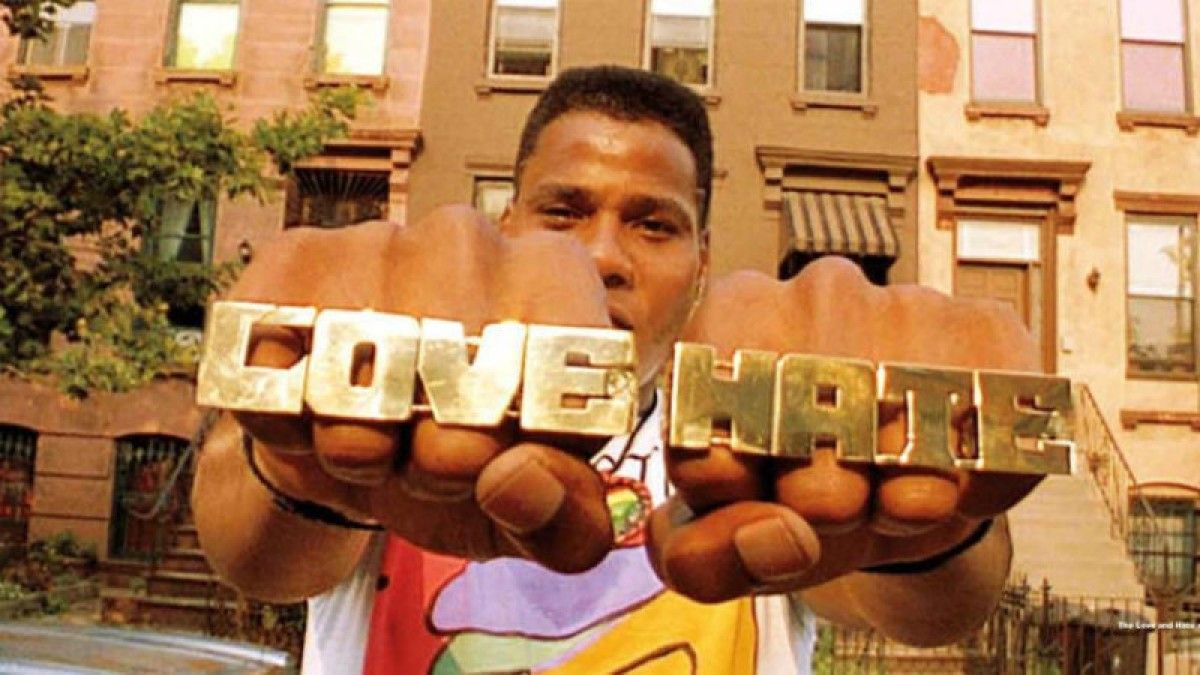
As I mentioned at the start of this piece, when I met Lee, I talked to him about the moment where Radio Raheem finally tells the story of LOVE and HATE, the two giant gold fist plates that he wears. The monologue he delivers is a barely-reworked version of the monologue that Robert Mitchum delivers in Charles Laughton’s haunting Night Of The Hunter, and Bill Nunn makes it into one of the film’s most arresting moments. And while the scenes are similar, they make wildly different impacts in the two films.
In Night Of The Hunter, Mitchum’s trying to win the confidence of these children, but he’s also clearly trying to intimidate them, and the story he tells is presented in very folksy terms, masking a malice that is very close to the surface.
Ah, little lad, you’re staring at my fingers. Would you like me to tell you the little story of right hand, left hand? The story of good and evil? H! A! T! E! It was with this left hand that old brother Cain struck the blow that laid his brother low. L! O! V! E! You see these fingers, dearhearts? These fingers has veins that run straight to the soul of man. The Right Hand, friends… the hand of love. Now watch, and I’ll show you the story of life. Those fingers, dearhearts, is always a-warring and a-tugging, one again’ t’other. Now watch ‘em! Old brother Left Hand, left hand, he’s a-fighting, and it looks like love’s a goner. But wait a minute! Hot dog! Love’s a-winning! Yes-sirree! It’s Love that’s won, and old Left Hand Hate is down for the count!
When Radio Raheem tells the story, he’s telling the story of what black American culture has to do in its effort to belong to the mainstream. Love has to be the message, but hate is right there, earned and raw, and it feels most days like hate is winning the day. When you combine this scene with the way Smiley (Roger Guenever Smith in a role that was added late in the production process) is constantly pushing M-M-M-M-Martin and M-M-M-Malcolm in our faces, it’s clear that Lee’s title is an unanswerable question, a zen koan akin to “What is the sound of one hand clapping?” How, in an America that is as fundamentally rigged as the one presented in this film, is anyone supposed to do the right thing? Is there even a right thing to do anymore? Or have we created a situation that is doomed to just simmer along, erupting from time to time without any real change?
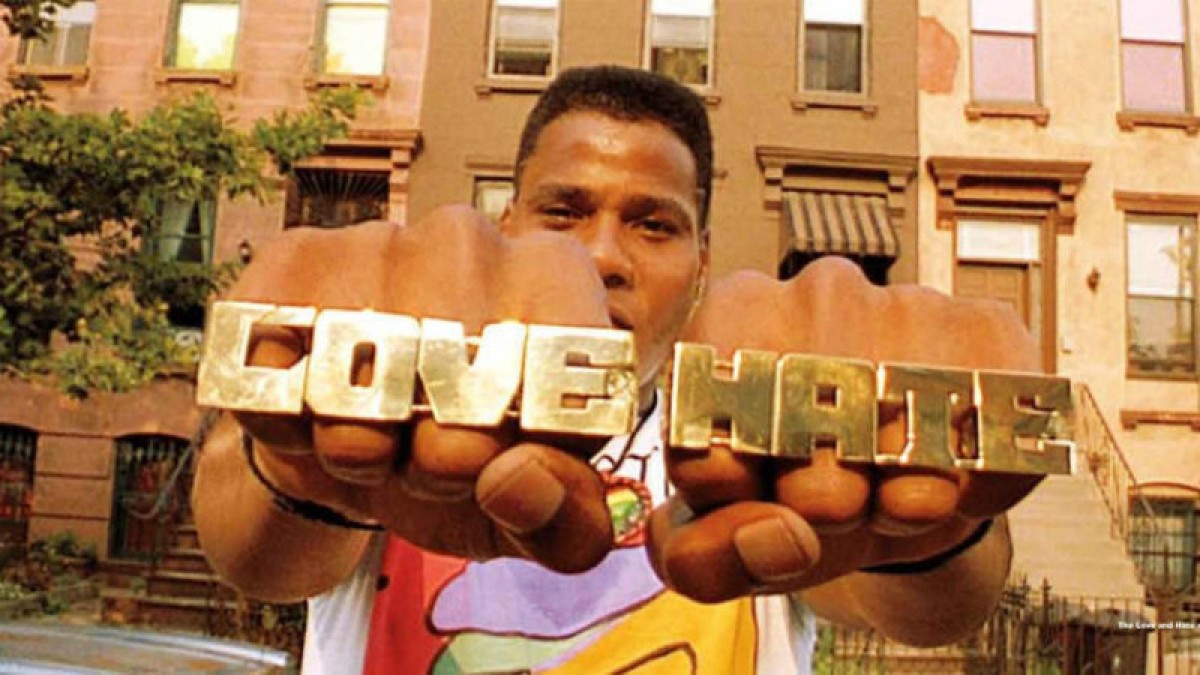
Let me tell you the story of Right Hand, Left Hand. It’s a tale of good and evil. Hate! It was with this hand that Cain iced his brother. Love! These five fingers, they go straight to the soul of man. The Right Hand: The Hand Of Love. The story of life is this: static. One hand is always fighting the other hand, and the Left Hand is kicking much ass. I mean, it looks like the Right Hand, Love, is finished. But hold on! Stop the presses! The Right Hand is coming back! Yeah, he’s got the Left Hand on the ropes now, that’s right! Oooh, it’s a devastating right, and Hate is hurt! He’s down! Left Hand Hate KO’ed by Love!
It is a battle that must be fought, of course, and especially when confronted by a world that is unjust, a world that judges you not for the content of your character, but for the color of your skin. It is simplistic to say that Martin Luther King Jr. was a perfect pacifist while Malcolm X was a pure militant. That’s not true in either case, and it reduces these men who had to wrestle with these two halves of their own hearts to archetypes. Spike almost dares you to judge these characters early in his film, and then he keeps piling on more friction. He turns the temperature up… and up… and up… and up… and he starts to set these characters in orbit around each other in a way that guarantees that by the end of the day, something’s going to explode.
One of the weird miracles of Do The Right Thing is that the film is fall-down funny for much of its running time. Part of that is just the casting, and part of it is because Spike Lee can’t help himself. He’s always been fond of finding the joke in everything, and the public character he played from the very start is wry and funny. There’s a moment where Radio Raheem is trying to buy batteries from Sonny, and it’s getting more and more tense as the scene plays out until Sonny finally swears at Radio Raheem in frustration and Radio Raheem… laughs. Because he sees what’s happening, and his own role in it, and how frustrated Sonny is, and it suddenly defuses the whole thing. It’s a beautiful little human moment in the midst of so many great beautiful human moments in the film, well-observed and very potent in terms of the observation it makes about how we handle conflict in general.
But when the film finally stops kidding around, things take a terrifying turn, and they do so in the same horrible, sudden, unexpected way they do in real life. An altercation with Sal gets bigger and bigger until Sal does the unthinkable. “I KILLED YOUR FUCKING RADIO!” he bellows at Radio Raheem, and that transgression feels more insane than if Sal had actually attacked Radio Raheem directly. There is something so personal and so pointed about smashing his radio to pieces, and when that fight spills out into the street, it’s awful and it’s ugly, but it’s still just a fight.
And then the police arrive.
And when they wade in, something unforgivable happens.
There’s no turning back once they kill Radio Raheem, and the way they do it is particularly ugly. Choking him to death when he’s already defenseless, the police set off a truly explosive situation, and when Mookie picks that garbage can up, you can argue that what he’s really doing is saving the lives of those policemen. When he puts it through the window, he kicks off an outpouring of violence, but it’s against the shop. It’s not against Sal and his sons directly, and it’s not against the cops. And while it’s still a major violation, one that I suspect Sal will never fully shake, it could have been worse. And finding that very narrow line to walk, that’s the real trick for anyone living in an America that routinely feels less than welcoming to them.
Here’s the thing… I get why Spike Lee’s people came outside looking for someone else to be the first person to ask a question at that event all those years ago. Do The Right Thing wasn’t a movie made directly for me. They had an idea of what Spike Lee’s fans were supposed to look like. And if Spike had been at the theater the day I saw the film for the first time, I don’t think our conversation afterward would have been a good one. But over the course of that summer, watching that film over and over and then soaking in the script and in the song that gave the film its pulse, I fell in love with it on a very deep level. I fell in love with each of the characters, with the sense of life on that block on that day, and with the way they speak to each other and about each other and at each other. No other film he’s made has that same rowdy perfect sense of life, but small wonder.
Do The Right Thing isn’t just the best Spike Lee film; it’s one of the best movies about America and race language, full-stop, and each time I return to it, I am struck by the way it continues to hold up a mirror to who we are, and it’s heartbreaking to realize that 30 years later, the wound at the center of the film hasn’t remotely begun to heal.
NOTE: Yes, I’ve published this before. Bear with me as I reprint a few things that I want to be included in this official Hip Pocket series. The way the Internet works, it’s clear that anything I’ve written that I want to preserve, it’s up to me to take care of that.